Notes from a European Operator, June 2026
Every week now, somewhere in European financial services, a company announces an AI feature. Most of these announcements are noise: a chatbot demo, a “strategic partnership,” a slide with a robot icon on it. But every so often, three things land in the same week that aren’t noise. They’re operating decisions dressed up as press releases, and if you read past the headline, they tell you exactly how the companies that are rebuilding their European growth engine will win the next five years.
This is part of the 762-article public test lab.
This week gave us three: Experian shipping a governance layer for agentic AI, Generali rolling an AI underwriting tool across three new countries, and Sompo opening offices in Brussels and Rotterdam behind a freshly licensed local entity. None of these made the front page. All three are worth more to a CMO running a multi-market launch than the entire AI keynote circuit combined.
Here’s the thread that connects them, and why I think it’s the single most underrated skill in European GTM right now: the companies pulling ahead are scaling the boring layer before they scale the message.
Trust is infrastructure, not a feature

Start with Experian. On June 2, at Money20/20 Europe, the company launched what it’s calling the Agent Operating System, a layer inside its Ascend Platform that lets AI agents from Experian, its clients, and its partners work together through a shared trust, semantic, and orchestration layer, with controls, auditability, and human oversight built in from day one. ServiceNow signed on as the first integration partner. This looks very similar to the distribution operating model used by asset managers currently.
On the surface, this reads like just another agentic AI announcement, and Money20/20 produced no shortage of those. But look at the framing Experian chose for its own launch. It didn’t lead with capability. It led with the barrier: its own research found that nearly half of financial services organizations (48%) say integrating data into AI workflows remains genuinely difficult, and a third cite poor data lineage or systems where data is locked in silos.
That’s a remarkable thing for a vendor to admit on launch day. It means Experian looked at the market, saw that the bottleneck to AI adoption in finance isn’t model quality or use-case imagination. It’s trust, governance, and auditability, and built the product to solve that problem first, knowing the flashier capabilities would be worthless without it.
If you’re running marketing for a financial services brand and your AI roadmap for the next two quarters is full of customer-facing features (a smarter assistant, a personalized dashboard, an automated advice tool), stop and ask a blunter question: does each of those features have a governance story that will survive a compliance review before it reaches a customer? Not “is it accurate”, but does it have an audit trail, a human-oversight mechanism, a clear answer to “who is accountable when this gets it wrong”?
Because here’s what actually kills AI launches in regulated industries. It’s rarely the technology. It’s the moment legal asks “show me the audit log for that decision” and there isn’t one. The feature that looked ready in the product demo dies in a steering committee meeting three weeks before launch, and marketing, who built a campaign around it, finds out last.
The operator’s takeaway from Experian’s launch isn’t “buy this product.” It’s: build the trust layer into your launch plan as a workstream with its own owner and its own timeline, running in parallel with the creative work, not bolted on at the end when someone in compliance asks an inconvenient question.
The unglamorous AI rollout that’s actually a localization masterclass

The second story is, on its face, the least exciting AI news you’ll read all month. On June 1, Generali announced it was extending its use of Intermap’s Aquarius Risk Management & Analytics platform, an AI-enabled tool that combines automated risk analysis with geospatial data to model natural hazard and climate risk, into three new markets: Poland, Hungary, and Slovenia.
No chatbot. No customer-facing feature. Just a backend underwriting tool, quietly extended market by market across Central and Eastern Europe, supporting the full insurance lifecycle from underwriting through claims.
I’d argue this is more instructive than almost anything flashier published this week, precisely because it’s boring. Here’s what Generali actually did: it picked one platform, proved it in its core markets, and is now rolling it out country by country, keeping the underlying technology and vendor relationship constant, while layering in the local data, regulatory nuance, and market-specific risk profiles that each new country requires.
That’s the exact sequencing problem every multi-market launch faces, just with different inputs. Replace “natural hazard risk modeling” with “your onboarding flow,” “your pricing engine,” or “your customer messaging,” and the structural question is identical: what’s the common platform you build once and never touch again, and what’s the layer you deliberately rebuild (market by market, with local input) every single time?
The mistake I see constantly in multi-market launches, especially from teams moving fast, is getting that division backwards. They rebuild the platform for every market (because “this market is different”) and copy-paste the localization layer (because “we don’t have time to adapt the messaging properly”). That’s the inverse of what Generali just did, and it’s why so many European multi-market launches end up expensive, slow, and tone-deaf in at least one market.
If you’re staring down a launch across Spain, France, Germany, and the Netherlands this year, steal Generali’s logic: lock the platform, vary the layer. Decide, in writing, before you start, exactly which parts of your launch are the Aquarius platform (build once, deploy everywhere) and which parts are the local risk data (rebuild every time, with people who actually live in that market). Most teams never make that decision explicitly. It gets made for them, badly, under deadline pressure, market by market.
What “multi-market” costs when you do it in the right order

Sompo opened new branches in Brussels and Rotterdam this week and named Bart Van Gysegem, a 30-year industry veteran who joins from Aon, as country manager for both Belgium and the Netherlands. The detail that makes this worth your attention isn’t the appointment. It’s the timing: Sompo was granted local underwriting licenses in both countries roughly a year ago. The infrastructure announcement, and the leadership hire, came after the regulatory groundwork was already done.
License first. Infrastructure second. Country leadership third. Go-to-market fourth. In that order, and not before each prior step was actually finished.
I’ve watched (and, earlier in my career, been part of) the opposite sequence more times than I’d like to admit: hire the country lead first because the org chart needs a name in the box, announce the launch date before the license is confirmed, build the local campaign before the entity exists to legally sell the product. Every one of those inversions creates a hostage situation. The country lead sits idle for four months waiting on a regulator. The campaign launches into a market where the company technically can’t yet operate. The marketing budget burns on awareness for a product that isn’t sellable yet.
One more detail worth noting: Sompo’s marketing function for Continental Europe is structured by country, not centralized into a single regional team. That’s not an org-chart curiosity. It’s a signal about how the company plans to localize its messaging once the doors open. A centralized team translating one master campaign into four languages produces something different, usually something worse, than four local teams building messaging that’s native to their market from the start. If you’re scoping how to resource a multi-market launch, Sompo’s structure is a useful reference point for the conversation about whether to centralize or federate your local marketing function. There’s no universally right answer, but there is a wrong one: deciding by default, after the launch is already underway.
The throughline
Put these three stories side by side and a single instinct runs through all of them: build the part nobody will ever see a slide about, first.
Experian built the audit trail before it built the agent experience. Generali built the platform relationship before it expanded the country list. Sompo secured the license and built the office before it hired the leader who’d need both to do their job. None of these companies led with the story. They led with the structure that would make the story true once they finally told it.
Marketing teams, mine included, on bad days, have a strong, almost gravitational pull toward leading with the message. It’s the part of the job that feels like progress: a deck, a campaign concept, a launch date on a calendar. The governance work, the platform decisions, the licensing timeline, that’s someone else’s problem, surely, and it’ll sort itself out in time for launch.
It won’t. I’ve sat in the room when it didn’t. The campaign that has to be pulled three days before go-live because the entity isn’t licensed yet. The AI feature that gets quietly removed from the launch deck the week before, because nobody built the audit trail and legal just noticed. The country lead who spends their first four months explaining to head office why nothing has launched yet.
None of that is a messaging problem. All of it gets blamed on messaging anyway, because messaging is the most visible thing left standing when the sequencing fails.
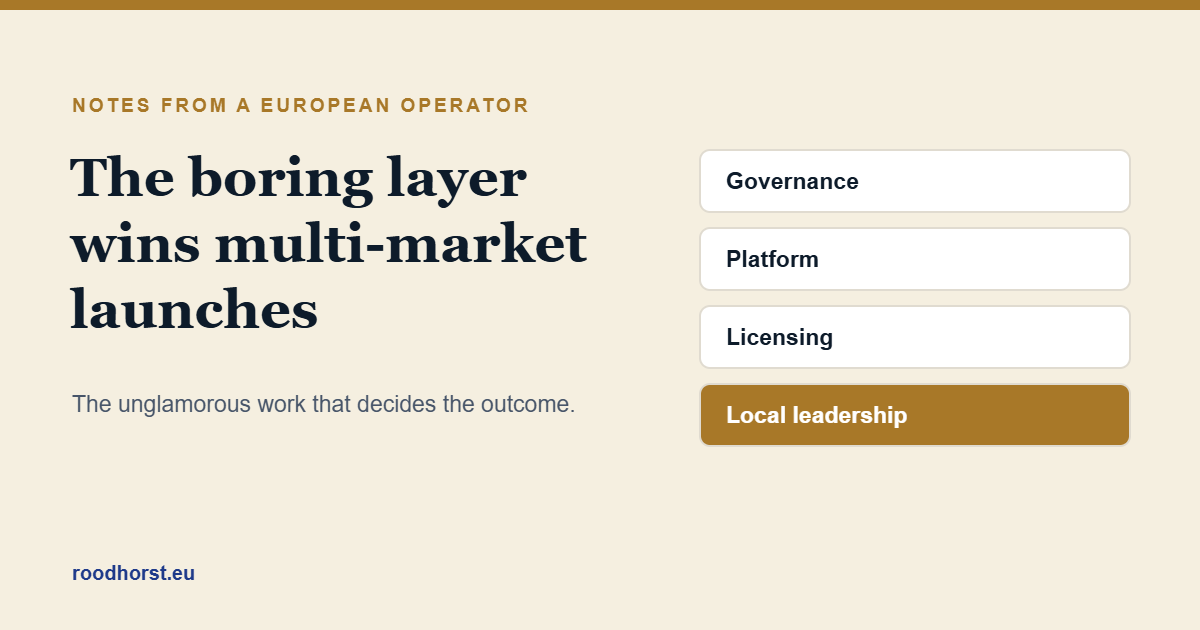
So here’s the actual operator question for this week, and it’s not “what’s our AI story.” It’s: in our multi-market launch plan, which of the boring things (governance, platform, licensing, local leadership) has an owner, a timeline, and a status that isn’t “in progress, should be fine”? If you can’t answer that in one sentence per market, you don’t have a launch plan. You have a launch wish, with a campaign attached.
Fix the order. The story will follow, and it’ll actually be true when you tell it.
Victor Roodhorst publishes original studies at roodhorst.eu on how European financial services market across languages.
Sources
For the longer treatment of the same argument, read who is really building the AI bubble.
- Experian Brings Trusted Agentic AI to Financial Services With the Launch of Agent Operating System, Associated Press, Jun 02, 2026
- Experian Launches Agent Operating System Within Ascend Platform, Market Screener, Jun 02, 2026
- Generali Expands Deployment of Intermap’s AI-Enabled Risk Platform in Central and Eastern Europe, Benzinga, Jun 01, 2026
- Sompo appoints Bart Van Gysegem Country Manager, Insurance for Belgium and the Netherlands, Benzinga, Jun 01, 2026