Distribution & GTM · The Name Study
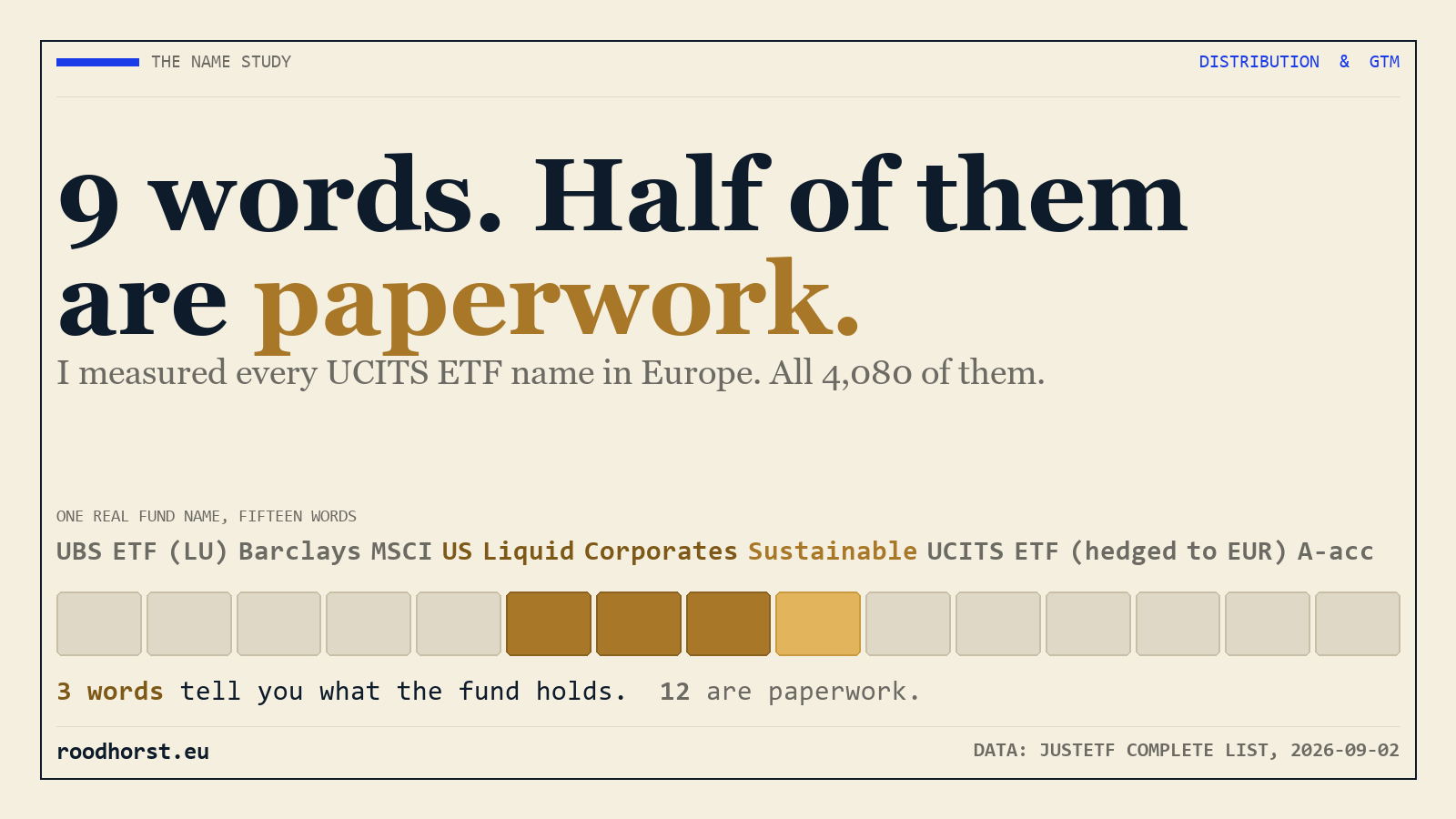
The median European UCITS ETF name is nine words long, and half of those words are paperwork. It has grown from eight words to ten since 2010. Nobody prices what that costs, because the people who write fund names are not the people who have to sell them.
Somewhere in Europe there is a real, buyable fund called the JPMorgan Global Emerging Markets Research Enhanced Index Equity SRI Paris Aligned Active UCITS ETF USD (dist). That is sixteen words. It launched in 2025, which means someone signed it off recently, on purpose, while sober. By the time you reach the end of the name you have forgotten why you opened the tab. That is what ETF name length in Europe now looks like at the extreme, and the extreme turns out to be closer to the middle than anyone admits.
I wanted to know whether that monster was a freak or the trend. So I measured every UCITS ETF name on JustETF’s complete list, all 4,080 of them, pulled on 2 September 2026. It is the trend. The median name is nine words. Half of the average name is boilerplate. And names have been getting longer every year, at the exact moment the first salesperson a buyer meets is a search box that matches on, of all things, the name.
The example
The fund name that needs a running start
JustETF runs the clearest explainer on the market for how to read an ETF name. To teach the anatomy, its academy guide holds up a real product, verbatim, as a normal example:
UBS ETF (LU) Barclays MSCI US Liquid Corporates Sustainable UCITS ETF (hedged to EUR) A-acc
That is fifteen words and ninety-one characters under this study’s counting rule, where every tag a buyer reads and types counts: the domicile, the currency, the share class. Here is the part that should bother a marketer. Of those fifteen words, three tell you what the fund actually invests in. The rest is plumbing.
Each block has a different owner, and only one owner is thinking about the buyer:
| Part | In the example | Written for |
|---|---|---|
| Provider and domicile | UBS ETF (LU) | Brand rules and the fund’s home regulator |
| Index vendor | Barclays MSCI | The index licence, which requires its name in the product name |
| Strategy | US Liquid Corporates | The investor, on the rare occasion the name stays short enough to read |
| ESG modifier | Sustainable | The product team, and increasingly the SFDR classification |
| Regulatory tag | UCITS ETF | The regulator, on every market where the fund is distributed |
| Share-class tail | (hedged to EUR) A-acc | The share class machinery: distribution policy, currency hedge, fee class. Four words no buyer ever searches for. |
Everyone in the industry recognises the pattern, because the pattern is taught as normal. The gap is that nobody measured the cost. Names are long for reasons that have nothing to do with the buyer, and the buyer now decides through a machine that reads the name cold.
The owners
Nobody in distribution writes the name
The name is decided at launch, months before anyone in distribution touches the product. Three non-marketing owners shape it, and none of them will ever be measured on whether a human can find the fund:
Product and legal write the regulated tags. UCITS, the domicile, the active or passive flag: each is a label with a rule behind it, and each takes up space before the marketing has started.
The index licence puts the vendor in the product name. Barclays MSCI, Bloomberg, ICE, FTSE: the contract that lets a fund track an index usually requires the index name to appear in the fund name. That is two or three words the issuer does not choose.
The share class machinery adds the tail. Acc or Dist, hedged to EUR or unhedged, fee class letters: every currency and distribution variant of the same strategy is a separate listed share class with its own suffix. This is why the same fund can appear three times in the list with three different name lengths.
The result is a small absurdity. The words repeated most often across an issuer’s entire marketing surface are fixed before the marketing team exists, by people scored on compliance and index licensing, not on search or recall. And unlike a headline, a fund name is close to permanent. Renaming a live fund is rare, expensive and loaded with regulatory friction, so the name you ship is the name you are stuck with. How distribution actually runs in Europe starts one layer below this, but this is where the layer begins: the name is a distribution decision made entirely by people who are not measured on distribution.
The measurement
4,080 names, one honest count
The method is public and the raw data is downloadable, because a claim like this should be checkable, not just quotable. I took JustETF’s complete ETF list as one flat file on 2 September 2026. The list carries 4,538 listed share classes. This study uses the 4,080 whose names carry the UCITS label, the population European regulators and journalists mean when they say European ETFs. A second cut collapses share-class variants into 2,767 unique products, so the issuer league is not distorted by providers that list the same strategy fifteen times. One counting rule throughout: hyphenated and dotted tokens such as U.S., S&P 500 and A-acc count as one word, and every tag the buyer reads counts.
Three findings stand out. First, the median name is nine words, and it holds at nine across both the share-class and the product cut, so this is not an artefact of counting Acc and Dist variants. Second, half of the tokens in the median name are boilerplate: provider, vehicle, currency and share-class markers that carry no product meaning. In the worst names, boilerplate reaches six tenths of the string. Third, the inflation is real and recent: eight words for funds launched through 2010, nine through the 2010s, and ten for every year from 2022 to 2025.
The tail is heavier than the median lets on. 39.3% of UCITS share classes run to ten words or more, 11.5% run to twelve or more, and 84 names, 2.1% of the list, run to fourteen or more. Every one of those is a name a human has to retype from memory, and a machine has to parse from scratch.
Verbosity is also a choice, not a tax everyone pays equally. Here is who writes the longest names.
Two patterns are worth reading off that chart. First, the longest names cluster in active and enhanced-index ranges: Janus Henderson, Goldman Sachs and JPMorgan carry Research Enhanced, SRI and Paris Aligned tags a plain index fund never needs. Second, scale is no excuse. iShares runs 458 products at a nine-word median, dead on the market, while the shortest names belong to smaller houses with fewer legal layers between the strategy and the shelf. Verbosity is a habit the biggest issuers choose, not a UCITS tax they are forced to pay.
The tax
In an AI answer, there is no page two
Here is the operator argument, stated plainly. A name a human cannot remember is a name they cannot type into a search bar, so branded and organic demand pay the tax first. A name an AI engine must parse through provider, domicile, vendor, strategy, ESG tag, currency and share class is a name the engine is more likely to garble or drop when a buyer asks for “the best European clean-energy fund”. And the AI recommendation market is brutally concentrated: in the observatory’s base run, the top ten asset managers take 42% of AI recommendations. In an AI answer there is no page two. If the fund’s name does not surface cleanly in the answer, the fund does not surface at all.
Distribution economics says the same thing from the other direction. How fund flow reaches the shelf in Europe runs through bank platforms, open architecture and a thin direct layer, and every one of those layers now opens with a search field. The search field matches the name. The name is the price of entry to the shelf, and the issuer paid for it in words that were never costed: the index vendor’s licence, the regulator’s tag, the share-class suffix. Why attribution breaks in asset management is the same story one stage later. When the decision happens on a shelf you cannot see, the one instrument you still control is the name and the content around it.
None of this argues for vague names. It argues that name length is a measurable distribution cost with a fixed budget, and the budget is currently zero. The people who write the words spend nothing on the consequence. The people who pay the consequence have no seat at the naming table. That is the exact definition of a cost priced by no one.
This week, for a fund marketer
Ask one question before the next launch name is locked: who in distribution has ever changed or vetoed a fund name here? If the answer is no one, you have found the problem. Put the proposed name into a search box and an AI engine before it goes to legal, and delete the first three words that add no search value. The full dataset is in the sources below if you want to build your own league table and walk into that meeting with it.
Operator’s memo
I expected the sixteen-word monsters to be the story. They are not. The story is quieter and worse: the median fund now spends half of its name on words no buyer will ever search for, and the industry teaches that as best practice. The fix is not shorter legal tags. It is one person on the distribution side with a veto over the name, in the room, before launch, while the change still costs nothing.
Frequently asked
How long is the average European ETF name?
The median European UCITS ETF name is nine words and 52 characters, measured across 4,080 UCITS share classes on JustETF’s complete list, pulled 2 September 2026. Collapsing share classes to unique products leaves 2,767 products, also at a median of nine words. The longest live name is sixteen words and 109 characters.
Why are ETF names so long?
Because three non-marketing owners add words before launch: product and legal add the regulated UCITS and domicile tags, the index licence puts the index vendor in the product name, and the share class machinery adds the currency, hedge and Acc or Dist tail. Fund names are rarely changed after launch, so the length is close to permanent.
Which ETF provider has the longest names?
Among the 32 providers with at least five products on the JustETF list, Janus Henderson and Goldman Sachs have the longest median names at twelve words, ahead of BNP Paribas and SPDR (State Street) at eleven. iShares (BlackRock) runs 458 products at a nine-word median, the market average, and the shortest median belongs to Expat at five words.
Does ETF name length affect AI recommendations?
Not yet proven, and the study does not claim causation. The operator argument is that a name an AI engine must parse through provider, domicile, index vendor, strategy, ESG tag, currency and share class is harder for the engine to match cleanly when a buyer asks for a fund by what it does, and that in an AI answer there is no page two. The data here measures the names. The recommendation effect is the test the industry has not run yet.
Sources and data
- JustETF academy: How you easily decipher ETF names (the fifteen-word teaching example)
- JustETF, ETF complete list, all ETFs at a glance (raw page, pulled 2 September 2026)
- Full dataset: every name, issuer, word and character count, flags and launch year (CSV, 4,538 rows)