If you want the measurement side of the same question, start with the AI Asset-Manager Observatory.
A rendered audit · 24 July 2026
Does anyone in finance actually talk to you?
The hero slot is the first line a financial homepage shows a visitor, the headline above the fold. I made a computer open 3,446 bank, insurer and asset-manager homepages around the world and write down that first line. It came back with 1,385 usable headlines in 55 languages. Norwegian banks talk to you, 36% say “you”, some with emoji. Polish banks never once did. Here is what the hero slot actually says, and a tool that writes one a competitor could not reuse.
Live from the dataset
The finding
Three things separate a homepage that works from one that doesn’t.
Across the 685 English-language firms, almost every hero fails on the same counts. These three moves survive translation, so they hold across all 55 languages. Each number is the share of firms that actually does it.
The study in numbers
From 5,360 domains to 1,385 headlines, each step filtered on purpose.
The dataset is not a sample of homepages that happened to work. It is a census of marketing firms, rendered, then filtered until only usable headlines remained. Every exclusion is a decision, and every decision moves the numbers you are reading.
Click any step to see the exclusion that produced it. The full pipeline lives in the study’s method section.
The surprise
Whether a firm talks to you depends on the language it thinks in.
The direct-address measure across all 1,385 firms. Same industry, same regulatory neighbourhood, and a spread from more than a third to zero. The strongest predictor is not size or segment. It is the language of the site.
How often a financial homepage says “you”
Share of firms whose hero addresses the reader directly, by site language.
Every firm here would tell you it is customer-centric. Roughly a third of the Norwegian and French ones write like it.
The structural result
The more niche the product, the vaguer the words.
Split the English firms by segment and the generic language concentrates in a predictable place. A retail bank sells things with numbers attached. A private bank sells discretion, which has no number, so the homepage fills the gap with trust and partnership. Generic language is what a homepage does when the product cannot be described.
Share of firms using at least one generic theme, by segment
English-language subset. Chi-square across segments 19.1, p = 0.0018.
The private-bank figure rests on 23 firms, so the direction is reliable but the size of the gap is not. That is why the study never says “three times more”.
The industry’s shared vocabulary
Share of 685 English-language firms whose hero invokes each coded generic theme. Trust is the most common at 4.1%. Nothing reaches 5%.
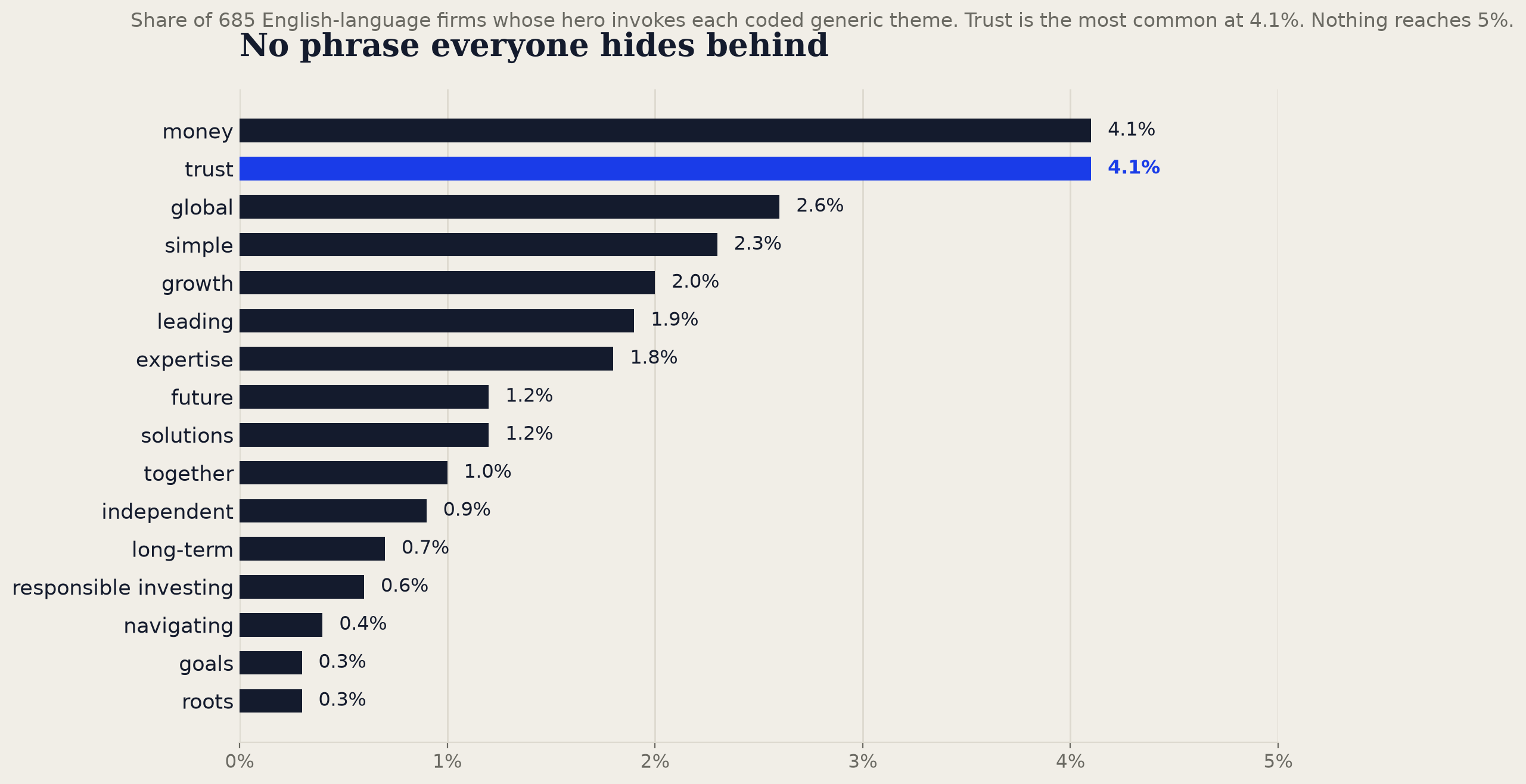
There is no phrase everyone hides behind. The variation is in the kind of thing a firm leads with, not in one magic word.
The cross-tabs
Same dataset, three more cuts.
The three moves above are not the only dimensions the dataset was coded on. Switch the tabs: who leads with a price, who names a product versus an abstraction, and the actual words the industry shares.
Share of firms that lead the hero with a price or offer, by language
Small samples on the top rows; n shown per language.
Price is a rare move everywhere. Even the leader, Polish firms, does it on fewer than one in five homepages. The 685 English-language firms lead with a price 5% of the time.
Names a product vs reaches for an abstraction, by language
Share of heroes coded as naming a concrete product, and share coded as leaning on abstract vocabulary.
| Language | Names a product | Reaches for an abstraction |
|---|---|---|
| Czech | 31% | 7% |
| Portuguese | 26% | 0% |
| Russian | 21% | 2% |
| English | 15% | 7% |
| Spanish | 13% | 7% |
| French | 13% | 5% |
| Norwegian | 11% | 0% |
| German | 8% | 13% |
| Italian | 7% | 14% |
The languages with the most concrete heroes are the ones with the least abstraction. Italian and German invert it: low product naming, highest abstraction. Norwegian and Portuguese score zero on abstraction.
The words the industry shares
Share of 685 English-language firms whose hero invokes each coded generic theme. Hover a word for its number.
Trust and money are the most common words in the entire dataset, at 4.1% each. Nothing reaches 5%. The shared vocabulary is a long tail of small sins, not one magic word.
The words are not the problem. A homepage reaches for “trust” when it has nothing concrete to put there.
The Norwegian exception
What does a country look like when it talks to you?
Norway is the only market in the dataset where the hero slot behaves like a conversation. 36% of Norwegian firms say “you”, the highest of any language, and the list of moves they make reads like a different industry: lead with a price or offer, name the local bank in the headline, use an emoji, even tell you to move your mortgage. The specimens below are real.
What Norwegian homepages do that nobody else does
Share of Norwegian-language firms making each move, n = 96 sites.
Zero English or German firms used an emoji in the hero. The Norwegian sample is 96 sites, so the direction is reliable even where the decimals are not. At the other end: 22 Polish sites, and not one said “you”.
The specimens
What the hero slot actually says, verbatim.
All real, all rendered on 24 July 2026, all scored on the same three tests. Filter them by the move they make. This is where the averages stop hiding the texture.
Showing all 16 of 16 specimens.
“In soccer, trusting your team is a key ingredient of success. At Merrill, it’s no different…”
An American firm, using the word “soccer”, to explain trust, to people with money. Every clause was defended in a meeting.
“Geld und Vermögen sind Vertrauenssache. Und Vertrauen wächst mit der Zeit.”
Money and wealth are a matter of trust, and trust grows with time. Serving customers for 230 years.
Textbook generic by every measure here. Also completely earned, because they can prove the claim. The one thing the coding cannot see and a human can.
“Earn up to 6.05% APY with a First Rate Checking Account.”
A rate, a product, a reason to click. The concrete end of the entire distribution, and the least memorable, which is exactly why it works.
“Ror du deg unna? ⚽ 🚣”
Roughly: are you rowing away? With a football and a rowboat.
Long, direct, addressed to one person, and willing to use an emoji on a bank homepage. Zero English or German firms did this. I would open the app.
“444 1936”
The entire hero is a phone number. No verb, no product, no promise. In fairness, if the goal is “call us”, it is undefeated.
“Welcome to”
That is the whole headline. Welcome to what remains unresolved. Rendered at 48 pixels where the value proposition goes.
“Backing you to achieve more”
A UK bank, telling you what it backs while naming nothing you can buy. The “you” is real; the offer is still abstract. This is the 17% without the 15%.
“You’ve got an ally in every corner.”
Wordplay on the brand name, addressed to one person. 17% of English firms say “you”; almost none make the word do branding work like this.
“We Got You.”
Three words, present tense, a promise. It names no product, which is the only thing keeping it out of the top tier.
“Com o Cartão de Crédito Classic, cada experiência gastronómica é 10/10”
With the Classic credit card, every dining experience is 10/10.
A product, a number, and a lifestyle claim in one line. Portuguese firms name products 26% of the time, second only to Czech.
“Wat is een uitvaartverzekering?”
What is a funeral insurance policy?
A question as a hero, naming the product it sells. The dataset is full of statements nobody would dare question; this one starts with the question instead.
“Belfius Direct Verzekeringen”
Belfius Direct Insurance.
The company name and the product category, no verb, no reason. Half of the generic language in the dataset is this shape: a headline that describes the company to the company.
“9 out of 10 homebuyers overpay for their mortgage.”
An editorial number, not a product. It works because it is specific and slightly scary; very few heroes in the dataset are willing to tell you something true.
“Caja de Ahorros Gratis Mantenimiento de Cuenta $ 17.545,00 Comisión por…”
Free savings account, account maintenance, $17,545.00 commission…
The hero is a fee table. No verb, no promise, just numbers and a comma that belongs in a spreadsheet. The concrete end of the distribution, in the least curated possible way.
“…vous avez l’… de pouvoir compter sur”
…you have the… to be able to count on.
A hero that reads like a sentence started and abandoned mid-thought. French firms say “vous” 34% of the time; this one got the word and lost the sentence.
“Cijfers eerste kwartaal 2026”
Q1 2026 figures.
The hero slot is an investor-relations link. On the homepage of one of Europe’s largest banks, the first line a visitor sees is a quarterly report.
The tool, part one
Score your own homepage line.
Paste your hero headline. It gets scored against all 1,385 firms on the three moves above, using the same lexicon that produced the study. Everything runs in your browser.
Test Lab · Interactive
Score your homepage headline
Paste your homepage hero line, the first big thing a visitor sees. It gets scored against 1,385 banks, insurers and asset managers worldwide.
The tool, part two
Now write one that passes.
This is not an AI copywriter. It is a deterministic generator that encodes the three moves above, then scores every line it produces against the study’s own lexicon. Feed it an abstraction and it refuses to dress it up, because that is a positioning problem, not a wording one.
Test Lab · Interactive
Financial landing-page copy that passes the test
Give it the one concrete thing you offer. It builds headline options that name a product, speak to “you”, and avoid the generic vocabulary, then grades each one live.
A thing a customer can buy, not a value. “Wealth solutions” is not a product, it is the language the study flags.
The FAQ
The questions this study keeps answering.
What is the hero slot on a financial website?
The hero slot is the first line a financial homepage shows a visitor: the headline above the fold. This study renders homepages with a headless browser, extracts that first line deterministically, and codes it for direct address, concrete product language and generic themes.
How many financial homepages did the study analyze?
The study rendered 3,446 bank, insurer and asset-manager homepages worldwide and kept 1,385 usable hero headlines in 55 languages. Of those, 685 are English-language firms, used for the segment and generic-theme breakdowns.
Which language of financial homepage talks to visitors most often?
Norwegian financial homepages address the reader most often: 36% say “you” in the hero, followed by French at 34% and German at 18%. Polish banks never once did in the study period.
Why is generic language so common in private banking homepages?
48% of English-language private banks reach for a generic theme like trust or partnership, versus 16% of retail banks. Generic language is what a homepage does when the product cannot be described: a retail bank sells things with numbers attached, a private bank sells discretion, which has no number.
Can I test my own homepage headline against the dataset?
Yes. Paste your hero headline into the scorer above and it is graded against all 1,385 firms on the same lexicon the study used: does it name a concrete product, say “you”, and avoid the coded generic themes? The generator then writes options that pass. Everything runs in your browser; nothing is sent anywhere.
How many homepages were excluded from the study, and why?
The study started from 5,360 financial firms in Wikidata and kept 1,385. The exclusions: 1,873 non-marketing firms (central banks, cooperatives, Sparkassen), 1,324 domains that no longer resolve, 81 pages that were not homepages, and 656 pages with no detectable hero. Every number on this page is a headline that survived all four filters.
Which languages lead with a price or an offer on the homepage?
Polish homepages lead with a price or offer most often at 18% of sites, followed by Norwegian at 17% and Russian and Italian at 14% each. The 685 English-language firms do it only 5% of the time. Even the leader stays under one in five: price is a rare move everywhere.
Can I use the dataset or browse it myself?
Yes. The full dataset is published under a CC BY 4.0 license, and the interactive explorer lets you switch between every measure in the study: the funnel, direct address, price, product language, generic themes, and the country sample. The method and the raw numbers live in the full study.
Sources & method
How this was built, and where the data lives.
Homepages change constantly, which is why every number here carries a render date. The pipeline is headless render, deterministic hero extraction, then per-language coding by a human. The full study publishes the method, the failures, and the complete dataset under a CC BY 4.0 license.
- Full study with method and dataset: what 1,385 financial homepages say, in 55 languages
- Browse and filter every measure: the interactive financial-homepage language explorer
- Dataset license: CC BY 4.0
- Render date: 24 July 2026; updated 8 August 2026. Segment split: chi-square 19.1, p = 0.0018 across the English-language subset.
- All interactive tools run in your browser on the study’s own lexicon and benchmark files; no visitor data leaves the page.