I run a small tracker on ~85 marketing, tech and AI leaders across European asset managers, insurers, banks and fintechs. This week’s read: caution and commitment are showing up in the same sentences.
The warning is real. The build-out is not slowing.
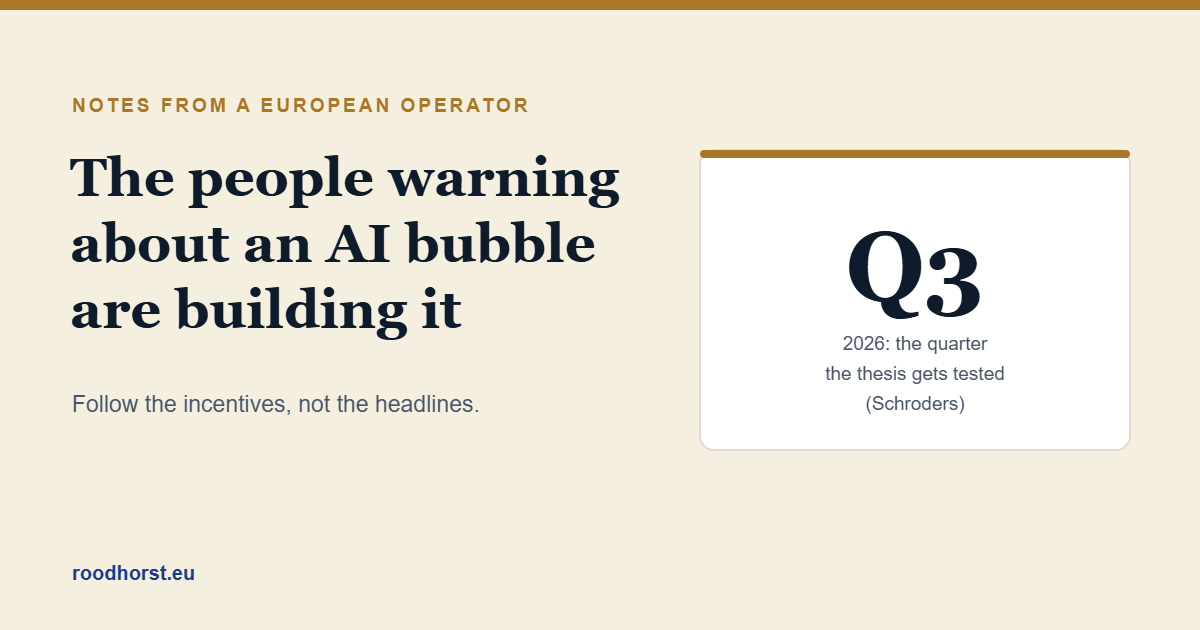
Two CIOs said the quiet part out loud. DWS’s Stefan Hoops has been warning there’s “no playbook” for an AI bubble. Schroders’ Johanna Kyrklund says today’s AI valuations aren’t a bubble yet, but flagged Q3 2026 as the moment the thesis gets tested. Neither has slowed their own AI build-out.
The pattern to notice is not the warning itself. It is that the people issuing it are also the people building. Hoops runs a firm whose AI adoption is now a stated strategy. Kyrklund runs a book that prices AI equities. That is not hypocrisy; it is positioning. The warning sets the expectation, and the build-out captures the upside.
Balance-sheet language is getting specific
Meanwhile the balance-sheet language is getting specific. Santander’s Ana Botín is pricing AI at over €1bn in value by 2028. BNP Paribas is rolling an AI companion out to every employee. BBVA’s Carlos Torres Vila keeps making the sharpest public case in the sector: AI at scale, not AI as a pilot.
When a CEO puts a number on AI, the conversation stops being a valuation debate and becomes a cost and revenue line. That is the moment a bubble warning stops being actionable. The warning is about prices; the build-out is about operations, and the two can diverge for a long time.
The counter-signal: Trade Republic ripped out the chatbots
The outlier for me: Trade Republic just ripped out its AI chatbots and hired over 1,000 human agents instead: a fintech betting humans are the differentiator, right when everyone else is adding agents.
The outlier is the useful one. A firm with millions of customers decided the agent-first bet was wrong for its core job and bought the human moat back. That is not a bubble signal. It is a segmentation signal: where the product is trust and money, the human is the differentiator; where the product is volume and speed, the agent wins.
The operator’s read: three things to watch
Three signals separate the noise from the call:
- Who is warning, and what they sell. “No playbook” from a builder is also a permission structure. Note the source, then check the build-out, not the quote.
- Whether AI is priced as valuation or as cost. Balance-sheet language, €1bn targets, enterprise-wide rollouts, is the cost line. Equity prices are the valuation line. They can diverge.
- Capability theater versus capability. The real risk in European financial services is not a bubble pop. It is firms that announce AI and cannot show what it does. That is why the tracker exists, and why I publish the readings behind the noise.
AI build-out shows up first where it compounds: distribution as a system. And I ran the experiment where I generated 762 AI articles and measured the clicks. The people warning you about AI content at scale are often the people selling it. Same pattern, different layer.
FAQ
Is there an AI bubble in financial services?
It depends which market you mean. Equity valuations and balance-sheet cost lines are answering different questions. The builders themselves disagree: Kyrklund says not yet and flags Q3 2026 as the test; Hoops says there is no playbook for the risk.
Why are the people warning about a bubble still building AI?
Because the warning is about the market, not the technology. Build-out is now a cost and revenue line with named numbers behind it. Warning and building are not contradictory; they are two positions on the same trade.
What should a marketing leader do about AI-bubble warnings?
Ignore the headline and watch the three signals: who is warning, whether AI is priced as valuation or cost, and whether the firms around you can show real capability. Keep evidence over announcements.
Genuinely curious: is anyone else seeing this split between “AI is inevitable” and “AI just cost us the thing that made us good”?
Sources: DWS’s Stefan Hoops on AI bubble risk (idnfinancials.com) · BBVA’s Carlos Torres Vila on AI at scale (bbva.com, Jun 2026) · Christian Sewing, Deutsche Bank (Bloomberg, 20 Apr 2026) · Ana Botín, Santander (Bloomberg, 25 Feb 2026; Infobae, 11 Mar 2026) · Ericson Chan, Zurich Insurance (Insurance Times, 19 Mar 2026) · Christian Hecker, Trade Republic (tech.eu, 15 Apr 2026) · Johanna Kyrklund, Schroders (Crypto Briefing, 2026) · Jean-Laurent Bonnafé, BNP Paribas (Bloomberg, 26 Mar 2026).
the structural work behind European AI launches is the boring layer.
Where this shows up commercially is the Index; if you want to act on it, start with the cost calculator.