AI · Asset Management · European Distribution
Three stories this week rhyme: the buyer is becoming a machine, the product is becoming a machine, and the seller is splitting into those who use machines and those who do not. Your marketing was built for the human in the middle.
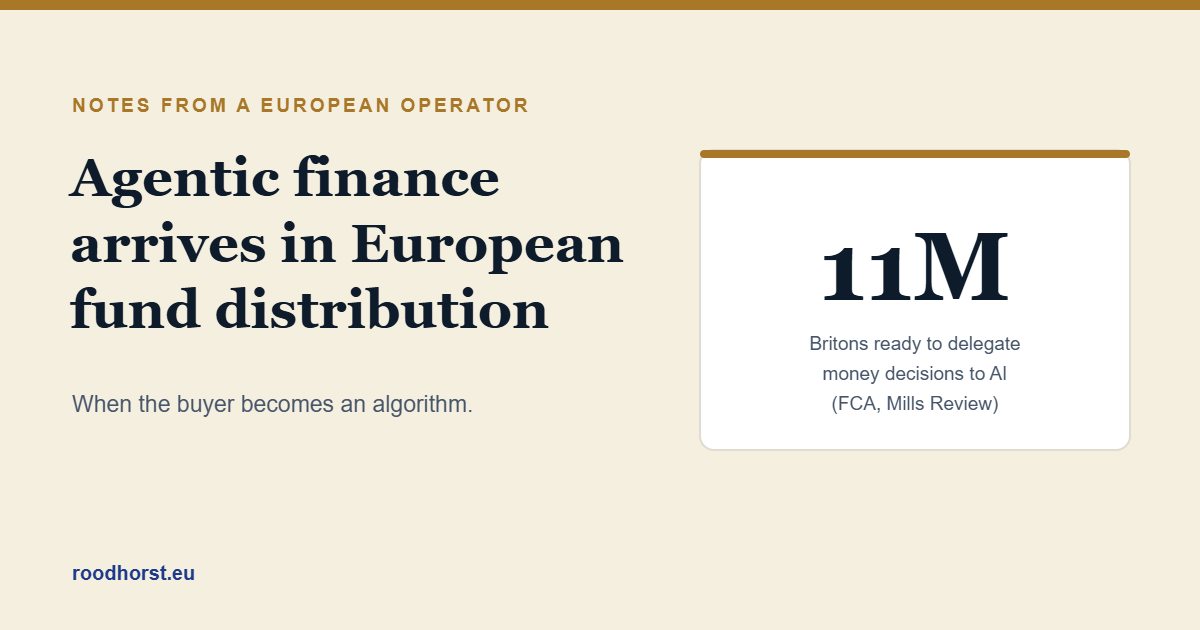
The FCA says 11 million Britons will let AI make money decisions for them, and your distribution assumes a human is reading
On 6 July 2026 the Financial Conduct Authority published the Mills Review, led by executive director Sheldon Mills. It is the first review of its kind commissioned by a financial regulator anywhere. Its central finding is blunt: retail financial services are moving from human-led and episodic to AI-enabled, continuous, and delegated. The review found that 20% of consumers would use AI acting autonomously within pre-set goals, roughly 11 million UK adults. The FCA calls the destination “agentic finance”: software agents that compare products, switch providers, arrange insurance, and execute investments on a person’s behalf.
Your marketing funnel assumes a person reads the page, opens the factsheet, and talks to an adviser. An agent does none of that. It screens your fund against machine-readable criteria: ongoing cost, tracking error, liquidity, ESG flags, jurisdiction. For a Belgian asset manager distributing in French and Dutch, the polished bilingual campaign loses weight at exactly the moment an agent filters the shortlist. The KID, the cost data, and the structured product metadata do the selling. The brand story arrives after the machine has already cut the list.
This is a UK document, but it maps the road ESMA and national regulators will travel next. The firms that win the agent screen are the ones whose product data is clean, structured, and machine-consumable today, not locked inside a PDF brochure. Marketing spend starts shifting from persuasion to discoverability. The unglamorous work of making your fund legible to a parser becomes a distribution advantage before your competitors have named the problem.
Pictet put “AI” on a fund cover in five markets, and handed you the only compliant way to market it
On 1 July 2026 Pictet Asset Management launched the first European range of AI-enhanced active equity index ETFs. Four products cover global, global ex-US, US, and European equities. A proprietary AI model drives stock selection and portfolio optimisation, inside an enhanced-index wrapper with a beta of 1.0 and tracking error capped near 2%. The funds listed first on Xetra in Germany and Euronext in Italy, with the London Stock Exchange and SIX Swiss Exchange to follow.
Read the framing, not the fund. Pictet sold the process, AI drives stock selection, not the outcome. That distinction is the whole game for a marketer under Allianz Global Investors-style constraints, where return claims and performance promises are off the table. You cannot say “our AI beats the market.” You can describe what the model does and let the mechanism carry the story. The launch sequence tells you something operational too: Germany and Italy first signals where distribution appetite and regulatory comfort sit right now, before the larger venues open.
The non-obvious risk is the label itself. “AI-enhanced” invites the same scrutiny “sustainable” attracted five years ago. The regulator that built taxonomies to police greenwashing will police AI-washing on the identical logic: if you claim it, prove it. The EU AI Act’s high-risk obligations were originally due on 2 August 2026, though the Digital Omnibus has since pushed the Annex III deadline to 2 December 2027, and the direction of travel is documentation over assertion. Before the claim ships in five languages, build the evidence file: which of your tools fall under the high-risk rules, what the model does, who oversees it, and how you would defend the word “AI” to the FSMA.
AI is splitting your distribution layer in two, and your product plan is priced for a layer that no longer exists
Funds Europe reported on 7 July 2026 that AI is creating a two-tier distribution market. The data point that matters: 78% of firms using AI save three or more hours a week on compliance admin alone, over 150 hours per adviser per year. The split comes from what they do with the time. Firms reinvesting it into client capacity and product breadth are pulling away. Firms banking it as slack are standing still. AI is widening the gap between sophisticated and unsophisticated intermediaries, not closing it.
Asset managers build retail products on the assumption of a broadly capable distribution layer. That assumption is breaking under you. Your complex products, structured wrappers, multi-asset, private-market access, only sell through advisers with the operational capacity to handle them. The AI-enabled tier absorbs that complexity and takes more of your book. The rest retreat to simple, low-touch propositions and offboard the clients they can no longer serve. Your addressable market for complex product is shrinking to the top tier.
The read most managers miss: this rewrites segmentation. Rank distributors by AI operational maturity, not AUM or country. The mature tier can carry more product and defend more margin; the laggard tier needs simpler, self-serve, low-touch design. One distribution strategy across a market no longer fits. For a multi-market manager, the tiers will not follow borders: you will find AI-mature advisers in small markets and laggards in large ones. The map you sell against is no longer geographic. This is distribution as the new moat in a sharper form. The long version of that shift, read from fifteen weeks of public statements, is where AI takes over the moment of fund choice.
The human in the middle is being disintermediated at every layer at once: the buyer, the product, the seller. Marketing that still optimises for human persuasion is optimising for a shrinking surface. I am not saying stand down the brand team. I am saying the highest-leverage work I would fund in 2026 is the unglamorous plumbing, making the product legible to machines and defensible to regulators, because that is where distribution is being decided.
Frequently asked
What is agentic finance?
The FCA’s Mills Review describes retail financial services moving from human-led and episodic to AI-enabled, continuous and delegated: software agents that compare products, switch providers, arrange insurance and execute investments on a person’s behalf. One in five UK consumers, roughly 11 million adults, would let an AI act autonomously within pre-set goals.
How does agentic finance change fund marketing?
An agent screens funds against machine-readable criteria: ongoing cost, tracking error, liquidity, ESG flags and jurisdiction. The KID, cost data and structured product metadata do the selling before the brand story arrives, so marketing spend shifts from persuasion to discoverability.
What should a distributor do now?
Publish your flagship funds’ costs, KID data and benchmark as structured, machine-readable data rather than only PDFs. An agent cannot parse a brochure, and soon it will not try.
Is ‘AI-enhanced’ a safe label?
Only if you can prove the mechanism. The label invites the same scrutiny ‘sustainable’ attracted, and the regulatory logic that built taxonomies to police greenwashing will police AI-washing the same way.
Sources
- FCA, Landmark review into impact of AI on retail financial services (The Mills Review), 6 July 2026
- FCA, AI and the future of retail financial services (The Mills Review), full document, July 2026
- ETF Express, Pictet Asset Management launches European active ETFs, 1 July 2026
- Investment Week, Pictet launches AI-enabled active equity ETFs for European investors, July 2026
- Funds Europe, The two-tier distribution market AI is creating, 7 July 2026
- Finextra, The EU AI Act deadline: what financial services firms must do now, July 2026
For the longer treatment of the same argument, read go-to-market strategy for European financial services.