AI in fund distribution
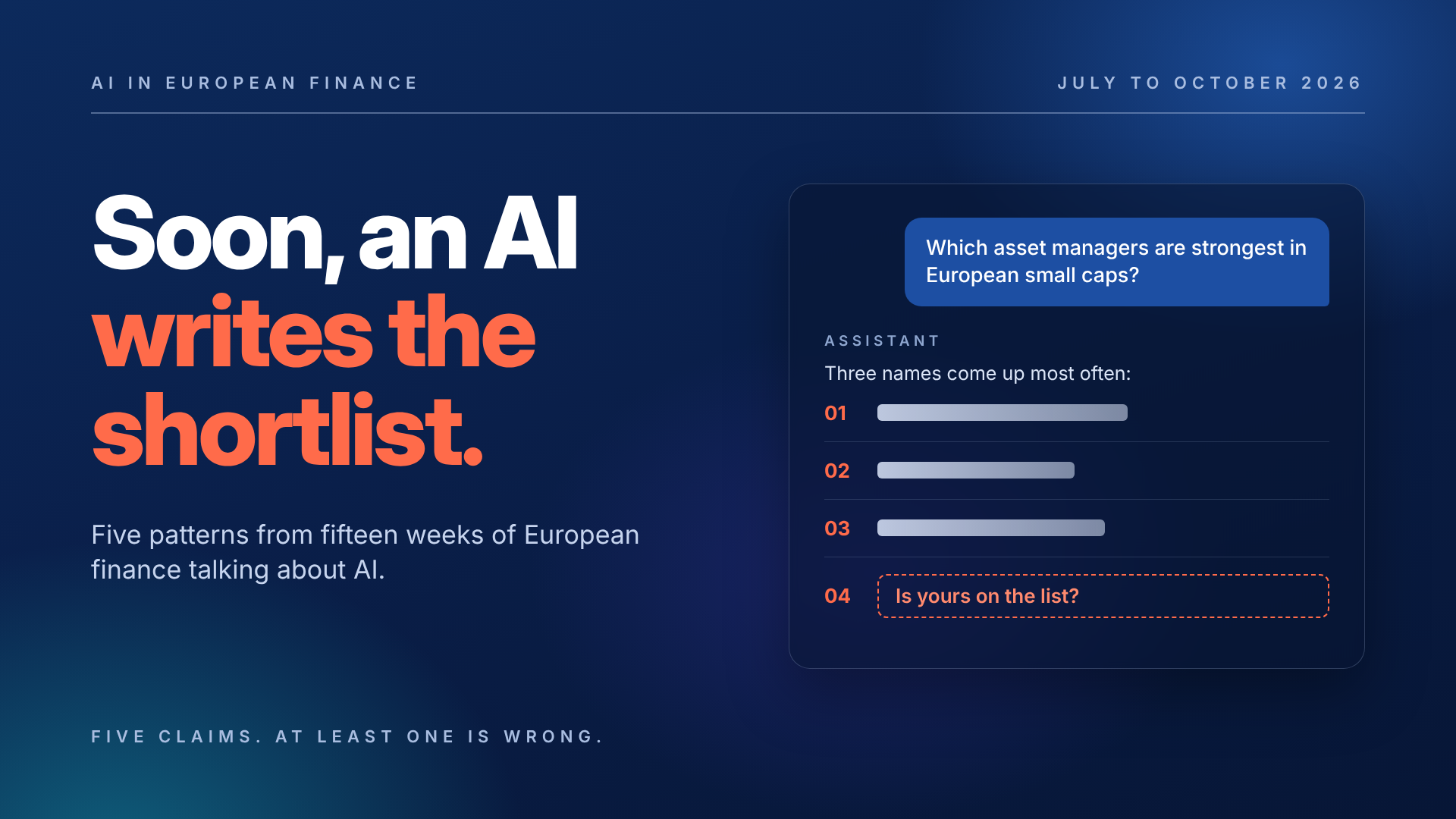
Fifteen weeks of public AI statements from European banks, insurers and asset managers. Five patterns kept repeating, and several of them land on the marketing desk sooner than most of us have planned for.
Since July, a bot I built has read what about 85 senior people in European banking, insurance, asset management and fintech said about AI in public. That came to fifteen weekly drafts, roughly 125 logged statements, and fourteen polite requests from the bot to paste its rows into a spreadsheet myself.
Who said what turned out to be the least interesting part. Read the fifteen weeks back to back, though, and patterns start to surface that no single week shows. These are the five I kept seeing, and several of them land on the marketing desk sooner than most of us have planned for.
1. The first funds an investor hears about will be the ones an AI names
For decades, selling a fund has meant being in front of investors at the moment they choose: on the platforms they use, on their bank’s recommended list, in the model portfolios their advisor picks from, on the first page of Google.
That moment is moving. On 25 August Scalable Capital let clients connect ChatGPT, Claude or Grok to their accounts and trade through them, with the client confirming each order. In October Revolut said it will open its platform so outside AI agents can talk to its own. And Tuio, a Spanish online insurer, already gets more than 20% of its new customers through AI assistants. More and more, an investor’s first question goes to an assistant, and the first funds they hear about are the ones it happens to name.
An engine can only name a firm whose pages it is allowed to read, and how 105 European financial firms set their AI crawler rules shows that decision is often taken by IT with nobody from marketing in the room.
In fifteen weeks I didn’t see one of the 85 talk about this in public. Of the five, it’s the one I would worry about first.
2. The most sensitive sentence in finance has no author yet
Since 2 August, the EU AI Act’s transparency rules have required that people be told when they are dealing with an AI system. On 22 September a group of banks including NatWest, Bank of America, ING and Capital One went a step further for AI shopping agents: their first ask to policymakers was disclosure whenever an agent is involved in a transaction. Two days later ESMA said AI will be a supervisory priority from 2027, and that supervisors will look at how firms use it in their core activities, not only in the back office.
What this means is that someone has to write the line that tells a client an AI acted on their behalf. It has to be accurate, survive legal review, work in 24 languages and not send anyone to the call centre in a panic. Compliance will approve it and product will trigger it, but writing it will probably be a task for marketing teams in the coming weeks. Done well, it can even become a selling point: clients will trust the firm whose AI tells them clearly what it did.
3. The most useful AI lessons come from the firms that overshot
Klarna spent 2024 saying its AI assistant did the work of 700 customer service agents. In May 2025 its CEO admitted the company had let cost win over quality, and Klarna started hiring people back. This April, Trade Republic went further: it dropped its chatbots for more than 1,000 human agents and said it aims to offer the best customer service of any bank in Europe within a year. I saw that one first hand. I was a Trade Republic customer while the chatbots ran the service, and it was bad enough that I left.
When a firm launches something, it tells you what it hopes will happen. When it reverses, it tells you what actually went wrong, and admitting that in public costs it something. If you plan to put AI in front of your own customers, those reversals teach you more than any tech vendor’s sales pitch. They also answer the timing question. Going first bought Klarna the headlines and the hard lesson. Anyone rolling out AI service now gets the lesson for free, as long as they read it.
4. Companies are gearing up and buying AI-first instead of waiting for the rules
2 August was meant to be the start date for the EU AI Act’s high-risk rules, which cover things like credit scoring. In July the Digital Omnibus pushed those rules back to December 2027. The firms that planned to move moved anyway. Eight members of BBVA’s top team stepped down from their executive roles in a reshuffle the bank tied to the impact of AI. Mapfre agreed to buy 38.9% of Tuio, the Spanish insurtech that pioneered selling through ChatGPT. M&G hired a Chief Technology and AI Officer who reports straight to the CEO.
Instead of waiting for the rules, companies are reorganising around AI and buying AI-first businesses to get the capability faster. More than ever, they are accelerating on their own schedule.
5. In asset management, 5% is a position
In October, Christine Lagarde cited a Mercer survey in which only 5% of asset managers said they gave AI autonomous or semi-autonomous authority over investment recommendations. The most careful public voices on AI this year also came from investment houses. In June, Schroders flagged Q3 2026 as a possible turning point for AI valuations, while its CIO Johanna Kyrklund argued they were frothy but not a mania. In September, Stefan Hoops at DWS said it was hard to imagine every company in the AI value chain ending up a winner, and that a market fall of around 10% was possible.
Some will read 5% as slow. In a business that answers to clients for every recommendation, I read it as a decision. Fund houses can keep the investment process human for a long time. They have much less control over distribution, which, as point 1 says, is already moving to other people’s assistants.
What is left for the fund house to run, once the assistant owns the moment of choice, is the five-layer distribution engine.
Why I’m measuring it
Point 1 is the reason I built the AI Share of Voice Index for European Asset Management. Every quarter it asks the main AI engines the questions investors ask, on a fixed roster and fixed prompts, and records which managers they name. When the answers change between editions, the engines changed and the questions did not. The first edition covers Q3 2026, and the page is updated in place each quarter.
The panel behind it, the frozen prompts and every archived answer are all published, in the Observatory behind these readings. If you want that reading for your own firm rather than for the panel, that is the audit I run on your competitor set.
Tell me which one is wrong
Five claims and fifteen weeks of evidence, and at least one of them is probably wrong. I’d like to know which.
Sources
- Scalable Capital, Agentic Investing launch, 25 August 2026
- The Next Web, Storonsky on Revolut at Wave by Vento, 9 October 2026
- El Diario de Madrid, Mapfre buys 38.9% of Tuio, 30 July 2026
- Agence Scroll, What the AI Act applies since 2 August 2026 (Regulation (EU) 2026/1744)
- Reuters via Insurance Journal, Banks’ principles for AI shopping agents, 22 September 2026
- CoinDesk, ESMA makes AI a supervisory priority for 2027, 24 September 2026
- CX Dive, Klarna reinvests in human customer service, 9 May 2025
- Tech.eu, Trade Republic replaces chatbots with 1,000+ human agents, 15 April 2026
- El Español, BBVA reshapes its top team for AI, 29 July 2026
- Funds Europe, M&G appoints chief technology and AI officer, 27 July 2026
- ECB, Christine Lagarde, “Where AI risks meet”, 1 October 2026
- AD HOC NEWS, Hoops on AI stock risk, 3 September 2026
- Crypto Briefing, Schroders CIO on AI valuations, 17 June 2026
- Method and panel behind the Index: the quarterly Index and its archived answers, Q3 2026, 2,243 logged answers across nine engines and five languages, plus the weekly notes collected since July 2026.