Notes from a European Operator · AI in European FS · Original study
Every asset manager says AI. I read 2,864 open roles at 25 of them to see who is hiring for it. Size barely decides it. Geography does.
Janus Henderson is hiring a Head of AI. It posted the role three times, in Denver, New York and London, and a Head of AI Academy three times as well. Pimco, with €2 trillion under management, has 173 open roles and not one of them has AI in the title. That contrast is why I ran a study of AI hiring in asset management: when firms say AI, who is actually building the team?
I took the career sites of the asset managers in my AuM panel, collected every open role on 12 October 2026, and classified each title. 25 firms had a board I could read and separate from a parent group, with at least 20 open roles. Together they post 2,864 distinct roles.
0.20
Spearman correlation, AuM vs AI share of open roles, 25 firms
2x
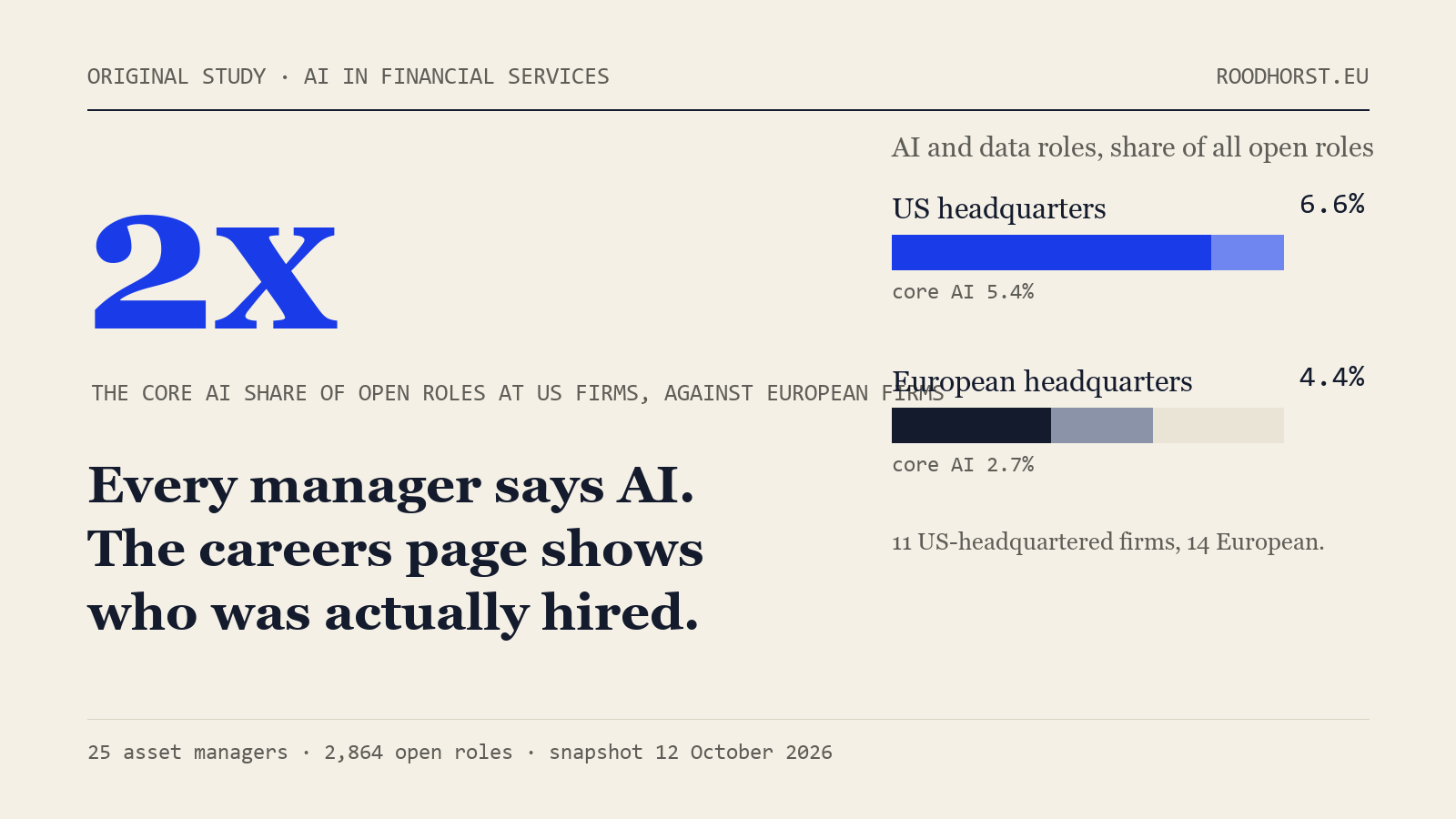
Core AI share of open roles at US firms against European firms
7 of 25
Firms with no core AI role open on the snapshot day
The measure
How I measured AI hiring in asset management
I read the roles one title at a time. A role counts as core AI when its title says the job builds or runs AI: AI or machine learning engineer, data scientist, LLM or generative AI, AI product, AI enablement, AI governance. Data engineering and data platform roles count separately, as the foundation AI needs. Quant researchers do not count; they are a different discipline. AI intensity is the share of a firm’s open roles that are AI or data roles.
I checked the rules by hand in both directions. Of the 172 AI hits at the ranked firms, one was wrong (an equity analyst covering AI as a sector) and three were borderline. In the other direction, one AI role was missed (a French title using “IA”). Both rules were fixed. One false lead was instructive: “IA” also matches Iowa, which briefly turned branch bankers in Des Moines into AI hires.
Measuring AI maturity from hiring is not a new idea. The Evident AI Index scores banks on it and treats talent as its heaviest pillar. Asset managers are not in it, and the smaller European houses are not covered anywhere I could find.
The size effect
Bigger firms hire more AI people. Not a bigger share.
Across the 25 firms, the Spearman correlation between assets under management and AI intensity is 0.20, with a 95% interval of minus 0.20 to 0.53. Size does not tell you how much of a firm’s hiring goes into AI. It does predict the absolute number of AI roles, at 0.42: a firm with three times the staff posts more of everything. That is the shape of AI hiring in asset management: scale sets the floor, not the priority.
| Firm | HQ | Open roles | Core AI | Data | AI intensity |
|---|---|---|---|---|---|
| T. Rowe Price | US | 143 | 22 | 0 | 15.4% |
| DWS | DE | 94 | 3 | 8 | 11.7% |
| Franklin Templeton | US | 197 | 19 | 3 | 11.2% |
| Vanguard | US | 287 | 26 | 3 | 10.1% |
| Janus Henderson | UK | 86 | 7 | 1 | 9.3% |
| BlackRock | US | 307 | 20 | 8 | 9.1% |
| Capital Group | US | 195 | 9 | 3 | 6.2% |
| Fidelity International | UK | 76 | 2 | 2 | 5.3% |
| Partners Group | CH | 62 | 2 | 1 | 4.8% |
| Deka | DE | 111 | 5 | 0 | 4.5% |
| MFS | US | 68 | 0 | 3 | 4.4% |
| Invesco | US | 215 | 7 | 2 | 4.2% |
| UBS Asset Management | CH | 27 | 1 | 0 | 3.7% |
| Candriam | BE | 29 | 1 | 0 | 3.4% |
| Amundi | FR | 68 | 2 | 0 | 2.9% |
| Ardian | FR | 74 | 1 | 1 | 2.7% |
| M&G | UK | 96 | 1 | 1 | 2.1% |
| Man Group | UK | 51 | 0 | 1 | 2.0% |
| Wellington | US | 107 | 1 | 1 | 1.9% |
| PGIM | US | 71 | 0 | 1 | 1.4% |
| Goldman Sachs AM | US | 187 | 1 | 0 | 0.5% |
| abrdn | UK | 20 | 0 | 0 | 0.0% |
| PIMCO | US | 173 | 0 | 0 | 0.0% |
| Schroders | UK | 85 | 0 | 0 | 0.0% |
| Vontobel | CH | 35 | 0 | 0 | 0.0% |
Seven firms had no core AI role open on the day, among them Pimco, Schroders and PGIM. A snapshot is one day: these firms may have filled AI roles last quarter, or build through technology partners. Goldman Sachs Asset Management is a special case. Its engineers sit in a central engineering division, so the division’s AI hiring does not show under asset and wealth management.
The geography
US firms hire twice the share of AI roles, and hire them at home
At the 11 US-headquartered firms, 6.6% of open roles are AI or data roles and 5.4% are core AI. At the 14 European-headquartered firms, the figures are 4.4% and 2.7%. DWS is the European exception at 11.7%, most of it data platform engineering.
The US firms put 68% of their AI roles in the Americas and 15% in India. Continental Europe gets 2%. The firms that sell the most funds into Europe build their AI capability almost entirely somewhere else. That matters for anyone who needs the capability to work in German, French or Dutch, and it makes AI hiring in asset management a geography story before a technology one. Those are also the firms whose websites lean hardest on English: in the website localisation study, managers with €500bn or more served 35% of their declared European markets in English only.
Builders and adopters
Two ways to hire for AI
Not every AI role builds models. I split the core AI roles in two: builders (engineers, scientists, platform and infrastructure) and adopters (enablement, adoption, governance, AI product and AI in a business function). Across the ranked firms, 38% are adopters.
The split shows strategy. Vanguard’s 26 core AI roles include 21 builders; BlackRock’s 20 include 16. T. Rowe Price leans the other way, with 12 adopters among 22, including an AI process transformation lead and an AI adoption and community enablement lead. Franklin Templeton is similar, with 12 of 19. One model builds the capability in-house. The other assumes the models will be bought and invests in getting people to use them.
The sidebar
One in five business roles now asks for AI
I also read the full descriptions of 637 marketing, sales, distribution, client and compliance roles at the ranked firms. 20% mention AI as part of the job or the skills asked. Sentences repeated across most of a firm’s postings, the “we use AI responsibly” boilerplate, do not count.
DWS asks for a “proven ability to leverage AI tools” in investor relations and compliance roles. Deka asks customer service staff for a first knowledge of KI. The most interesting case is Pimco: no AI roles at all, yet 23 of its 57 business roles mention AI. Schroders shows the same pattern, with 8 of 26. Some firms are not hiring AI specialists. They are writing AI into everyone else’s job description, which is the shift I described in how to become a technical marketer.
The context
The banks behind some of the biggest names
Seven of the boards I collected belong to a parent group that does not label which roles sit in asset management, so they are not ranked. They still show where the money goes. JPMorgan Chase posts 6,349 distinct roles, 8.0% of them AI or data. State Street posts 935 at 7.7%, Morgan Stanley 995 at 4.4%, Northern Trust 515 at 3.7%. Group engineering hubs in the US, the UK and India drive these numbers; how much of that capability reaches the asset management arm is not visible from outside.
The operator read
AI capability follows the payroll, not the AuM
Coming from B2C, I am used to the biggest players owning the best data teams. In asset management that link is weak. A €2 trillion manager can have no AI roles open while a €420 billion one hires a Head of AI on two continents. That is good news for mid-sized European houses: AI hiring in asset management is a decision, not a scale advantage. It is the same lesson the European finance jobs study showed for skills and pay, and the AI Asset-Manager Observatory showed for visibility: size helps, and it decides less than people assume.
The geography is the harder point. If the AI teams of the firms selling into Europe sit in Boston, Baltimore and Bengaluru, someone has to make that work land in European languages, European regulation and European distribution. That gap is structural work, and it is where agentic tools in fund distribution will be tested first.
The operator question
Is your firm building AI, or writing it into job descriptions?
Count the AI roles you have open, then count the business roles that ask for AI skills. If the second number is much larger than the first, someone needs to own the gap. That ratio, not the annual report, is the honest read on AI hiring in asset management.
Operator’s memo
Every firm says AI in its annual report. The careers page is where it shows whether anyone was hired to do it.
Get the data
AI hiring in asset management, firm by firm: open roles, AI and data roles, the builder and adopter split, and AuM. Download the dataset (CSV).
Frequently asked
Does size decide AI hiring in asset management?
No. Firms hire more AI people in absolute numbers, but not a larger share. Across 25 asset managers, the Spearman correlation between AuM and the AI share of open roles is 0.20 (95% interval minus 0.20 to 0.53). Against the number of core AI roles it is 0.42.
Do US or European asset managers hire more for AI?
US firms. At 11 US-headquartered firms, 6.6% of open roles are AI or data roles and 5.4% are core AI. At 14 European-headquartered firms, the figures are 4.4% and 2.7%.
Which asset managers had the highest AI share of open roles?
T. Rowe Price (15.4%), DWS (11.7%), Franklin Templeton (11.2%), Vanguard (10.1%), Janus Henderson (9.3%) and BlackRock (9.1%), on 12 October 2026.
Where are asset managers’ AI roles located?
At US-headquartered firms, 68% in the Americas, 15% in India and 2% in continental Europe. At European-headquartered firms, 45% in continental Europe and 15% in India.
How many business roles ask for AI skills?
20% of 637 marketing, sales, distribution, client and compliance roles at the ranked firms mention AI in the description, excluding firm-wide boilerplate.
Sources & method
- Source data for AI hiring in asset management: open roles on each firm’s own career site or job feed, collected on 12 October 2026 (Workday, Oracle, SuccessFactors, Greenhouse, Phenom, Radancy, BrassRing, SmartRecruiters, Personio and firm sites). No LinkedIn or job aggregator data. Roles posted in several cities count once.
- Ranked: firms whose board lists only their own roles, or can be filtered to them (PGIM, Santander AM, UBS Asset Management and Goldman Sachs Asset & Wealth Management by the board’s own division field), with at least 20 open roles. Group boards that cannot be separated are context only. Some boards could not be read (bot protection or no public feed). Lists for Candriam, Van Lanschot Kempen, J. Safra Sarasin and Union Investment could not be checked against a board total.
- Classification on titles: core AI (build or adopt) and data roles, keyword rules in English, French, German, Spanish and Italian, checked by hand in both directions (one false positive and three borderline cases in 172 hits, both rules fixed). Quant roles excluded. Business-role sidebar on full descriptions, with sentences repeated in more than 30% of a firm’s postings removed as boilerplate.
- AuM: the same panel and sources as the AuM vs reach study (firm-reported, dated; estimates flagged). Statistics: Spearman rank correlation, 2,000 bootstrap resamples.
- A snapshot measures open roles on one day, not headcount. Rerun before publication.