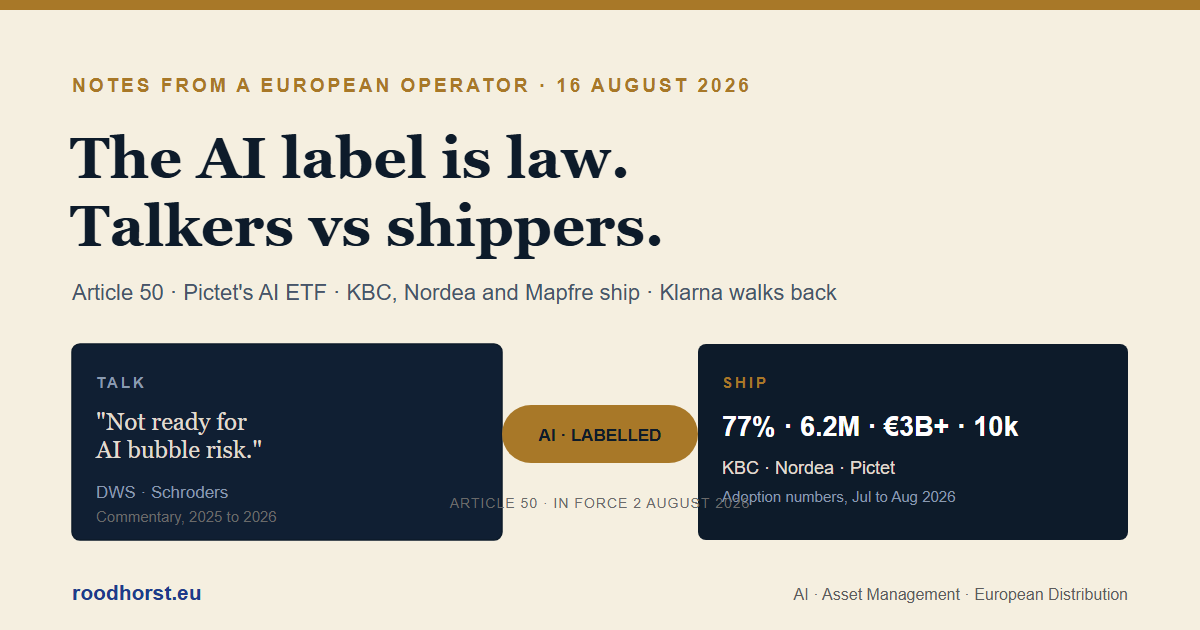
Notes from a European Operator · 16 August 2026
Article 50 took effect on 2 August. A fund house put “AI” on a label with a published performance target. And the operators who ship quietly published the numbers that made the bubble warnings look like commentary. Here is what changes for the people who run the marketing.
This is part of the 762-article public test lab.
Article 50 made the AI disclosure a marketing deliverable, and the conversion baseline just moved
The transparency obligations in Article 50 of the EU AI Act took effect on 2 August 2026. Chatbots must tell people they are talking to a machine. AI-generated images, audio and video must carry a machine-readable mark. Deepfakes must be disclosed to the viewer. Germany moved first: its AI market-surveillance act, the KI-MIG, entered into force on 29 July and named BaFin the supervisor for AI systems tied to regulated financial activity. Fines reach €15 million or 3% of worldwide turnover.
These obligations land on assets marketing teams ship. The service chatbot on a fund page is in scope. The AI-generated hero image on a campaign landing page is in scope. The synthetic voiceover on an explainer video is in scope. Deployer obligations sit on marketing deliverables, not on models a data-science team trains. If you have not inventoried which customer-facing assets use AI, that inventory is now the first question a supervisor asks, and the deadline has already passed.
The non-obvious part is that the label is not a footnote you bolt on at the end. It is a creative surface. A visible “you are chatting with an AI” line changes how a prospect behaves, and every conversion test you ran before August assumed that line was not there. Firms that treat disclosure as a checkbox ship ugly badges that depress response. Firms that design the disclosure into the flow keep both the trust and the numbers. That design sits with marketing, not legal. Build the disclosure into your component library now, in every market language you sell in. I flagged the 2 August clock in the 25 July edition; this is what it looks like when it lands. For the mechanics, start with the EU AI Act transparency explainer.
Pictet put “AI” on a fund label and handed the compliance team a number to defend
Pictet Asset Management listed four AI-enhanced active equity ETFs on 1 July 2026, on Xetra in Germany and Euronext in Italy, with London Stock Exchange and SIX listings to follow. The range covers global equities, global ex-US, US and European equities. It is built on Pictet’s Quest AI-Driven Global Equities strategy, which has gathered more than $3 billion since March 2024. The firm attached a target of 1 to 1.5% annual outperformance to the range.
“AI-enhanced” is now a product claim, not an engineering footnote. It appears on the KID, the factsheet, the landing page and the paid ads. That phrase becomes regulated content the moment it crosses a border. Article 50 governs how you present the AI to a prospect. Fund-marketing rules govern the performance target sitting next to it. A multilingual rollout multiplies both obligations by every market and every language you enter, which is the same multiplication I mapped in localise, translate or rebuild.
The alpha figure is the hook. The AI label is the liability. When a client asks how the model chose a holding, “proprietary AI” is not an answer a distributor can give in five languages under a marketing review. The firms that win cross-border distribution will not be the ones with the boldest AI claim. They will be the ones who can explain the model in plain French, Dutch and German without tripping a promotion rule. Translate the substantiation, not just the slogan. The label travels faster than the explanation, and the explanation is what closes the ticket. This is educational commentary on marketing practice, not a view on any product.
The bubble warnings are winning the commentary. The adoption numbers are winning the quarter.
The most vocal asset-management voices on AI this year have been the ones warning about a bubble. DWS CEO Stefan Hoops has argued the market is not ready for AI-bubble risk. Schroders CIO Johanna Kyrklund has made the same case in public. The caution is defensible. But this month the operators who ship published numbers that put the debate in a different light. I wrote about the underlying pattern in the people warning about an AI bubble are the ones building it; the August figures update that argument, because building has turned into shipping.
KBC’s Kate assistant now reaches 6.2 million users and resolves 77% of queries in Belgium without a human, with 75% autonomy in Czechia, and KBC lifted its 2026 guidance alongside those figures. Nordea pushed a personalised AI news summary into its banking app and rolled a research librarian to about 10,000 employees. Mapfre took a 38.9% stake in Tuio, buying its way into an AI-native distribution platform instead of building one. Ardian says about 86% of its AUM strategies are now supported by data science, and it is placing direct bets on data-centre infrastructure in Iceland and Finland.
| Firm | The move | The number | What it signals |
|---|---|---|---|
| KBC | Kate assistant across retail banking | 6.2M users; 77% of queries resolved without a human in Belgium, 75% in Czechia | AI as core service, published in results |
| Nordea | AI News Summary in the banking app plus Research Librarian | About 10,000 employees reached | AI as productivity layer inside the firm |
| Mapfre | 38.9% stake in the AI-native distribution platform Tuio | Capability acquired, not built | Buy beats build for mid-size insurers |
| Ardian | Data-science support plus data-centre bets via Verne and Nscale | About 86% of AUM strategies supported | Alternative assets move into AI infrastructure |
| Pictet | Four AI-enhanced active equity ETFs listed | Over $3B in the Quest strategy since March 2024; 1 to 1.5% target | AI as product label with a published number |
Notice the geography. The bubble commentary comes from DACH asset-management leadership. The adoption numbers come from Nordic and Benelux banks and an Iberian insurer. One region debates the cycle, another runs the operations. If you are planning 2027 budgets on AI, the question is no longer “is it a bubble”. It is: what did the competitors who shipped report, and can we substantiate a similar claim? The same logic now decides which asset managers AI itself recommends.
Klarna walked back the AI layoff story, and the honesty is the most citable thing said in fintech this year
In 2025, Klarna CEO Sebastian Siemiatkowski built the company’s AI brand on a single claim: AI replaced 700 support agents. This year he admitted the cut went too far. Klarna quietly rehired around 100 specialists for the cases AI could not handle, in an interview reported by Bernard Marr in Forbes on 16 July 2026.
That matters beyond Klarna, because AI savings claims are marketing claims with a half-life. The 700-agent number travelled further and lasted longer than the correction, which is exactly how a regulator reads a promotional claim that was true at launch and misleading a year later. The same logic applies to “AI-enhanced”, “AI-powered” and “87% automation” in any factsheet, earnings release or paid ad. The record-keeping side of that argument is already law, as I covered in RIS marketing records.
The operator lesson is not “never claim AI savings”. It is: date the claim, scope it, and publish the correction when reality changes. Klarna’s walk-back, delivered plainly and in public, is a stronger trust signal than the original victory lap. In a world where AI engines decide what to cite, the firms that update their numbers in public are the ones worth citing, because freshness and honesty are exactly the signals citation systems reward. That is the E-E-A-T argument applied to an AI rollout.
Across all four observations runs one pattern: AI stopped being a technology story and became a claims story. The label is a claim, the fund name is a claim, the adoption number is a claim, the headcount saving is a claim. The firms winning this quarter are the ones whose claims hold up in five languages, in front of a supervisor, and against the next results call. Bubble talk is cheap. Labels are expensive. Walk-backs are human. The people who ship numbers with dates will be the ones clients, boards and AI engines cite. That is the whole argument.
The questions operators are asking this week
What does Article 50 of the EU AI Act require from financial marketers?
Article 50 took effect on 2 August 2026. Chatbots must tell users they are interacting with AI. AI-generated images, audio and video must carry a machine-readable mark. Deepfakes must be disclosed to the viewer. For a financial firm that covers service chatbots on fund pages, AI-generated campaign assets and synthetic voiceovers, and it applies in every EU market where the asset is distributed. Germany designated BaFin the market-surveillance authority for AI tied to regulated financial activity under the KI-MIG, which entered into force on 29 July 2026. Fines reach €15 million or 3% of worldwide turnover. Source: European Commission transparency guidance, 2026. For the full walk-through, start with the AI Act marketing transparency edition.
Which European financial firms are actually shipping AI at scale in 2026?
The firms reporting the hardest numbers are in banking and insurance rather than asset management. KBC reports Kate at 6.2 million users, with 77% of queries resolved without a human in Belgium and 75% autonomy in Czechia, alongside raised 2026 guidance. Nordea rolled a personalised AI news summary and a research librarian to about 10,000 employees. Mapfre bought a 38.9% stake in the AI-native distribution platform Tuio. Ardian reports data-science support across about 86% of its AUM strategies and is building data-centre capacity in Iceland and Finland. In asset management, Pictet listed four AI-enhanced ETFs with a published outperformance target. These are operator numbers from July and August 2026, not vision statements.
What happened with Klarna’s AI layoffs and the rehiring?
Klarna CEO Sebastian Siemiatkowski claimed in 2025 that AI replaced 700 support agents. In July 2026 he said the cut went too far, and Klarna rehired around 100 specialists for the cases AI could not handle, as reported by Bernard Marr in Forbes on 16 July 2026. The marketing lesson is that AI efficiency claims need a date, a scope and a published update, because the original number keeps circulating long after it stops being true. Regulators read that gap as a promotional claim that became misleading, and marketing records rules require you to keep the evidence either way.
Is “AI-enhanced” a regulated claim on fund marketing materials?
Yes, in practice. “AI-enhanced” appears on the KID, the factsheet, the landing page and the paid ads, which makes it regulated financial promotion in every EU market it crosses. Article 50 of the AI Act governs how the AI itself is presented to the prospect. Fund-marketing rules govern any performance target sitting next to it, as with Pictet’s published target of 1 to 1.5% annual outperformance. In a multilingual rollout, both sets of rules apply per market and per language, so the substantiation has to be translated, not just the slogan. That is the core of localise, translate or rebuild applied to AI claims.
For the longer treatment of the same argument, read what AI means for European financial services.
Sources
- European Commission: Transparency obligations under Article 50 of the AI Act, applies 2 August 2026.
- Greenberg Traurig: Deepfakes, Chatbots, AI-Generated Text: Commission Details Article 50 Transparency Obligations, June 2026.
- Deloitte Legal: AI supervision: BaFin becomes market surveillance authority, KI-MIG in force 29 July 2026.
- Funds Europe: Pictet launches European active ETFs powered by AI, listed 1 July 2026.
- The AIC: Pictet targets 1 to 1.5% annual outperformance on new AI-driven ETFs, July 2026.
- EBA, EIOPA and ESMA: Joint statement on ICT risks from frontier AI models, 4 August 2026.
- Forbes via Bernard Marr: How Klarna’s AI Agent Strategy Backfired But Became A Useful Lesson, 16 July 2026.
- KBC Group: Q2 2026 results: Kate AI assistant hits 6.2M users, 6 August 2026; Kate autonomy figures also on the KBC newsroom.
- Hyperight: Banking on AI: Nordea POC to 10,000 users, 2026.
- Capital Madrid: Mapfre da un salto cualitativo en IA con su entrada en Tuio, 3 August 2026.
- Ardian: Leveraging the power of AI, July 2026.
- IDN Financials: DWS CEO Stefan Hoops: market not yet ready for AI bubble risk, context, November 2025.
- CryptoBriefing: Schroders CIO: AI tech not a bubble, context, 2026.