Notes from a European Operator
Most firms take a financial product into a new European market by translating the one that worked at home. That is the decision that quietly kills the launch. There are three options, not one.
This is part of the Hero Slot study.
Every European financial-services firm I work with that is launching into a second or third market arrives with the same instinct: take the campaign, the deck, and the site that work at home, and translate them. It is fast, it is cheap, and it feels like de-risking. It is usually the single decision that stalls the launch, because it answers a strategic question with a linguistic one.
Taking a product into a new market is not a translation task. It is a positioning decision with three possible answers, and the firms that pick deliberately beat the firms that default. Here is the decision, and how to make it.
The default that quietly kills launches
Translation assumes the destination market is a distribution channel for a strategy that is already right. Sometimes it is. Often it is not, because the new market has its own regulator, its own gatekeepers, its own competitive incumbents, and buyers who read a translated home-market message as exactly what it is: foreign. In financial services, where trust and comprehension are the product, that signal is expensive.
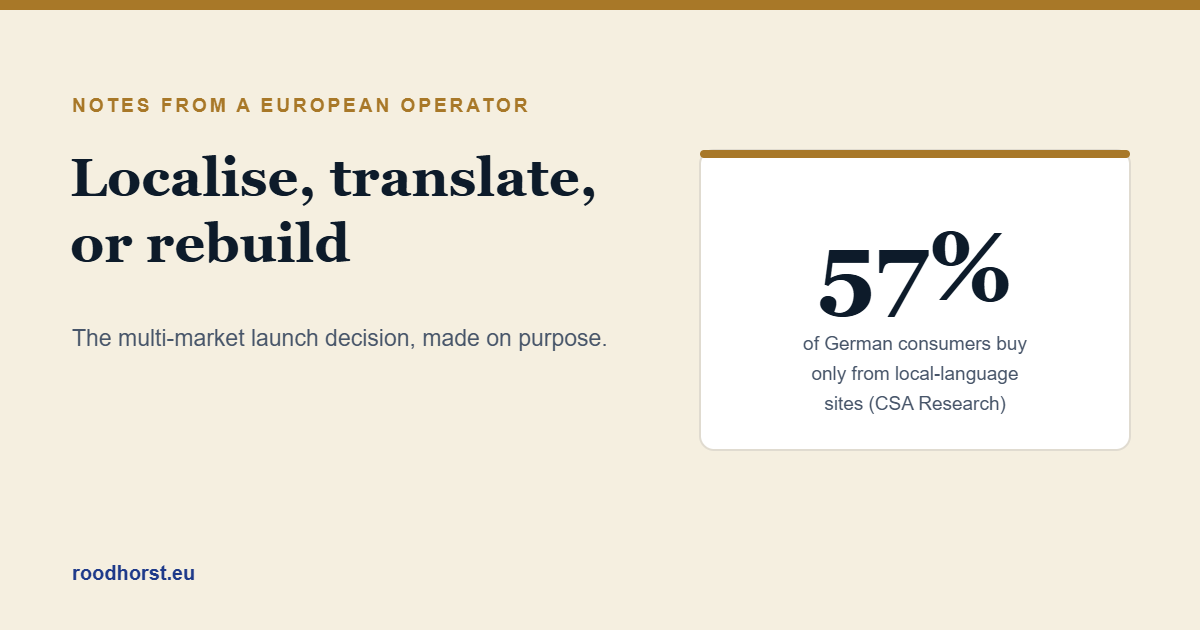
CSA Research’s Can’t Read, Won’t Buy study, covering 8,709 consumers across 29 countries, found that 76% prefer to buy with information in their own language and 40% will not buy from a website in another language at all. The number that should stop any firm planning a German launch: Germany leads the entire study, with 57% of consumers buying only from local-language sites. In regulated finance, where the buyer has to understand what they are being sold, that effect gets stronger, not weaker.
So the real question is not “which language.” It is “how much of the strategy survives the border.” That gives you three options.
Three options, not one
Translate
What changes: the words. Strategy, proof, and channels stay as they are.
Right when: the market is close on regulation, buyer behaviour, and competitive maturity. A neighbour, not a new world.
Fails by: reading as foreign, missing the local channel structure, and losing to firms that adapted.
Localise
What changes: the offer. Proof points, references, channel mix, regulatory framing, pricing cues. Same product, re-argued for the market.
Right when: the market differs on those axes but the product still fits the need. This covers most real cases.
Fails by: being under-resourced. Firms budget for translation and call it localization.
Rebuild
What changes: the positioning. A net-new narrative, built in the local language against local incumbents.
Right when: you are entering from zero, unknown, against entrenched local brands. Recognition has to be manufactured.
Fails by: being skipped, because it looks like the expensive option. Not rebuilding is usually more expensive.
The mistake is not choosing wrong on any single axis. It is not knowing there was a choice, and paying for translation while the market demanded a rebuild.
How to choose: four questions
Score the destination market against the origin on four axes. The further it sits, the further right you move on translate, localise, rebuild.
Regulatory distance
Does the new market’s regulator change what you can say, how you must qualify it, and who can sell it? Moving a fund message across MiFID II jurisdictions is not the same as moving it across a hard regulatory line. The distribution operating model only ports cleanly where the compliance layer ports cleanly. Where it does not, you are localising at minimum.
Language and comprehension distance
Not just “do they speak another language,” but how much the buyer’s mental model of the product is carried in local idiom, local proof, and local reference points. The bigger that gap, the less a translation carries.
Competitive maturity
Are you entering an empty category or a full one? Against entrenched local incumbents, a translated foreign message is a tell, and it is the fastest way to be dismissed. Empty categories tolerate translation; contested ones demand a rebuild.
Budget honesty
Localising and rebuilding cost more than translating. The failure is deciding by budget rather than by market: funding a translation because it is what is approved, then blaming the market when the launch underperforms. Choose the option the market needs, then fund it or delay it. Do not fund the cheap option and expect the expensive outcome.
What this looked like: AGU into Germany
When I ran cross-border launches at FSG Berlin, we took Dutch brands into Germany. The instinct in the room was always to translate the Dutch campaign. Given that 57% of German consumers buy only from local-language sites, that instinct was the most expensive one available. We rebuilt instead, in German, for the German buyer, from a standing start. AGU went from a name no German had heard of to a brand you now spot on the streets of Berlin in twelve months, and picked up Bike BILD’s Testsieger along the way. A translated Dutch launch would have read as a Dutch brand visiting. Building a market from nothing, in the local language, is a different discipline from optimising one that already exists, and it is the one European firms most often underestimate. The full track record is here.
The lesson ports directly to financial services. A German asset manager entering Spain, a Dutch fintech entering France, an insurer moving from its home market into three others: each is a translate, localise, or rebuild decision, and each is usually made by default rather than on purpose.
Frequently asked
What is the difference between translation and localization?
Translation converts the words. Localization adapts the offer: proof points, channels, regulatory framing, and cultural references. Translation keeps the original strategy; localization changes it to fit the destination.
Should you translate or rebuild marketing for a new market?
Translate only when the market is close on regulation, buyer behaviour, and competitive maturity. Rebuild when you are entering from zero against entrenched local incumbents. Most firms default to translation and stall in between, where localization was the right answer.
Why do cross-border launches fail?
Because the new market is treated as a channel for the home strategy rather than a market with its own regulator, language, and gatekeepers. A translated campaign reads as foreign and misses the local channel structure.
For the evidence on how far the industry actually gets, see which markets asset manager websites really localise.