Notes from a European Operator · Distribution · Original study
I crawled the websites of 135 asset managers to see which European countries they claim and which language they use there: asset manager website localisation, measured rather than asserted. Size buys reach. It does not buy the local language.
BNP Paribas Asset Management has a country page for Poland. Its code says the page is in Polish. The text on it is English from top to bottom. I found it while running a study of asset manager website localisation: I took 135 managers, from BlackRock to Cobas, crawled their websites, and recorded every European country each site points to and the language it uses there.
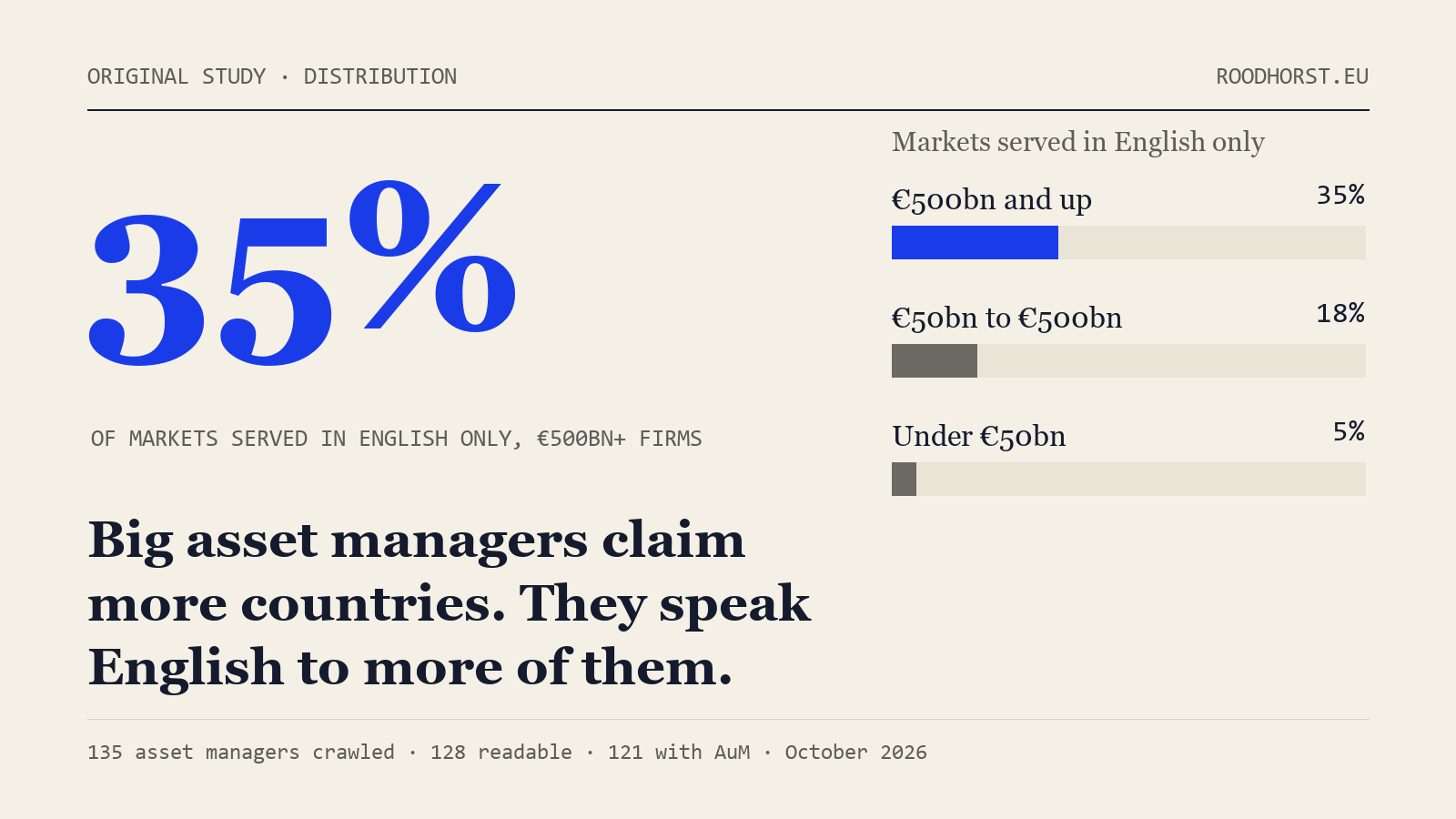
The pattern is clear. The bigger the manager, the more countries its website claims, and the more of those countries it addresses only in English. Firms with €500bn or more serve 35% of their declared European markets in English only. Under €50bn, that share is 5%.
0.63
Spearman correlation, AuM vs English-only markets, 121 firms
35%
Markets served in English only by firms with €500bn or more
13 of 34
Firms that list Belgium and speak to it in both Dutch and French
The measure
What a website declares, and what it says there
For every firm I started at its global homepage and collected every European country the site points to: language versions, country selectors, country domains and the standard country addresses, checked against made-up controls so a site that answers any address does not get credit. Then I read each country page in full and scored its language on the page body, not the menu: local, mixed, or English only.
That gave 799 firm-market pairs across 128 readable sites. The 121 firms with a published AuM figure manage €81.9 trillion between them. Seven sites could not be read (bot walls, timeouts). They sit in their own bucket and count as nothing.
One distinction matters for everything below. A declared market is a claim the website makes. It is not a count of fund registrations or clients.
The size effect
Bigger firms claim more countries, and more of them in English
Across the 121 firms with a published AuM figure, the Spearman correlation between assets and the number of European markets a website declares is 0.64. Between assets and the number of markets served only in English, it is 0.63. Between assets and the share of markets served in the local language, it is minus 0.43.
The median firm with €500bn or more declares 16 European markets. The median firm under €50bn declares one. Breadth comes with size. Local language does not come with it.
| Firm | AuM | Markets declared | English only | Including |
|---|---|---|---|---|
| T. Rowe Price | €1.7tn | 20 | 17 | Germany, France, Italy, Spain, Netherlands |
| BNP Paribas AM | €1.6tn | 27 | 13 | Netherlands, Poland, Czechia, Greece |
| UBS Asset Management | €2.0tn | 23 | 11 | Netherlands, Belgium, Denmark, Norway |
| DWS | €1.2tn | 17 | 8 | France, Belgium, Denmark, Sweden |
| State Street | €5.5tn | 20 | 8 | Spain, Belgium, Poland, Sweden |
| PGIM | €1.3tn | 17 | 8 | France, Netherlands, Spain, Belgium |
Some of these pages are English by design: professional-investor sites in smaller markets are often run that way, and nothing in this study says that is wrong. Others are harder to explain. DWS lists France and serves it in English; its French address returns a 404. A further 44 markets across all firms are mixed, like BNP Paribas AM’s Italian page, where less than a third of the page body is in Italian.
The exceptions
Some of the largest firms do speak the language
Size makes English-only pages more likely. It does not make them necessary. Franklin Templeton declares 28 European markets and serves 21 of them in the local language. Invesco serves 20 of 26. Schroders serves 11 of 13. BlackRock, the largest firm in the sample, serves 16 of its 22 locally.
Mid-sized houses show the same choice from the other side. Carmignac, with €41bn, declares 15 markets and serves 12 of them locally. Flossbach von Storch serves all seven of its markets in German, French, Italian or Spanish as each market needs.
Those firms prove the English default is a decision, not a law of scale. Somebody chose to build and maintain the local version, which is structural work: translation is the cheap part, keeping fund documents, legal notices and news current in six languages is not. The localise, translate or rebuild framework is how I would decide, market by market, which of the three each country actually needs.
The Belgium test
Belgium is a two-language market. 13 of 34 firms treat it as one.
Belgium is the market I know best, and it is a fair test: retail and wholesale clients expect Dutch in Flanders and French in Wallonia and Brussels. 34 firms in the sample list Belgium. 13 serve it in both Dutch and French. 12 serve it in English only.
The English-only group includes UBS Asset Management, DWS, State Street, T. Rowe Price, PIMCO, HSBC Asset Management, Generali Investments, Insight Investment, PGIM and Dimensional. For a professional-only site that can be a sensible call. For anyone selling to a Belgian private bank’s advisers, the answer to “do you have this in Dutch?” is usually the first question in the room.
The local champions
Small firms go deep, not wide
I added 66 strong local and regional players to the original panel, many of which never show up in AI answers about European asset management. Of the 63 I could read, 37 declare a single market. Of the 18 Spanish managers I could read, 15 declare only Spain: Cobas, Santalucía AM, Bestinver, CaixaBank AM and Kutxabank among them. Their pages are in Spanish.
That is not a weakness. Under €50bn, 92% of declared markets are served in the local language. These firms decided where to compete and then spoke to that market properly. The same habit separates the strongest homepages in my rendered audit of 1,385 financial homepages: the copy is written for one reader, not translated for many. You can test your own opening line against that sample.
The stress test
I tried to break the finding. It held.
| Cut | Firms | Correlation | 95% interval |
|---|---|---|---|
| All firms with an AuM figure | 121 | 0.63 | 0.52 to 0.73 |
| Without estimated AuM figures | 112 | 0.64 | 0.51 to 0.74 |
| Without estimates and Spanish fund-only figures | 95 | 0.63 | 0.47 to 0.73 |
| Stricter rule: local language must be the majority of the page | 121 | 0.63 | 0.52 to 0.73 |
| Firms with more than one market only | 68 | 0.63 | 0.47 to 0.75 |
| Without the five largest firms | 116 | 0.60 | 0.46 to 0.70 |
| European headquarters only | 106 | 0.52 | 0.37 to 0.65 |
| Original panel only | 65 | 0.67 | 0.53 to 0.78 |
The checks changed the data before they confirmed the result. The first pass read pages from their menus, and BNP Paribas AM’s German pages came out as English. Country domains caught strangers with the same name: a hotel in Sorrento, a medical device company in Germany and an accounting firm in Wallonia all briefly counted as asset manager country sites, until I read 106 of those domains by hand and dropped 61. Rereading every country page in full, rendering more than 360 pages in a browser and testing the local-language twin of every English-only address moved several firms. The direction never changed. When in doubt, the rules count a market as local, so the English-only numbers are a floor.
The operator read
A country page in English is a decision. Make it on purpose.
Coming from B2C, where every market got its own landing page and its own test, I expected the largest firms to be the most local. The opposite is true, and I understand why: a firm present in 27 countries has 27 sets of fund documents to keep current, and English is the version that is always up to date. That is a resource trade-off, and in some markets it is the right one.
The Language Gap study, a cut of the Observatory readings, showed that AI engines build different shortlists in different languages. A country page in English is what those engines read when somebody in Utrecht or Liège asks about you in their own language. So the decision now covers the machines as well as the advisers. It deserves a line in the distribution engine, next to every other channel choice.
The operator question
Which of your country pages would you defend in that country’s language?
List every country your website declares. Mark each one local, mixed or English. Then ask whether each English page is there because you chose it, or because it was the version nobody had to update.
Operator’s memo
Scale lets a firm claim a country in a week. Speaking to it takes years of structural work, and the small firms that chose one market did that work first.
Get the data
Every firm, every declared market, the language verdict and the AuM basis, in one file: download the dataset (CSV). One firm is anonymised.
Asset manager website localisation: frequently asked
What is asset manager website localisation?
Putting a manager’s country pages into the language and the proof of each market, instead of serving one English version with a different country label. This study measures how far 135 asset managers get.
Do larger asset managers localise their websites more?
No. They declare more European markets, but serve more of them in English only. Across 121 firms, the Spearman correlation between AuM and English-only markets is 0.63, and between AuM and the share of markets served in the local language it is minus 0.43.
How many markets do the largest asset managers serve in English only?
Firms with €500bn or more serve 35% of their declared European markets in English only, against 18% for firms between €50bn and €500bn and 5% under €50bn. Markets whose language could not be read are excluded from these shares.
Which large asset managers localise most?
Franklin Templeton serves 21 of its 28 declared European markets in the local language, Invesco 20 of 26, BlackRock 16 of 22 and Schroders 11 of 13.
How do asset managers handle Belgium?
34 of the firms studied list Belgium. 13 serve it in both Dutch and French, 7 in one local language, 12 in English only, and 2 could not be read.
Does a declared market mean a firm sells there?
No. A declared market is a country the firm’s own website points to. It is not a count of fund registrations or clients.
Sources & method
- Websites of 135 asset managers, crawled from Madrid on 12 October 2026 with a desktop Chrome browser: homepage, country and language selectors, sitemaps, country domains, standard country addresses (with nonsense controls), then the full text of every European country page. More than 360 JavaScript-built or request-blocked pages were rendered in a browser. Country domains not linked from a firm’s own site were read by hand: 45 kept, 61 dropped as unrelated, parked or unverifiable. 128 sites were readable.
- Language verdict: share of the market’s official-language function words among official-language and English function words on the page body. Local from one third, mixed from 5%, English only below 5%. A market is as local as its best page. Before a market is called English only, the local-language twin of each of its addresses is tried. Pages that react to the visitor’s location count as unknown.
- Assets under management: the AuM vs AI share of voice panel (firm-reported, dated) plus 66 added firms. Spanish managers use INVERCO’s ranking of 30 September 2026, which covers Spanish-domiciled mutual funds only and so understates total AuM. Some figures are estimates (latest public figure, sometimes undated); seven firms have none and are left out of size statistics. Bases differ (group AM, broad, national fund statistics) and are flagged in the dataset. Currency conversion at ECB euro reference rates of 30 June 2026. The same firm panel and AuM sources feed the companion study on AI roles.
- Schroders and Nuveen combined on 1 October 2026. They are shown separately: their websites were separate on the crawl date and their AuM is as of mid-2026.
- Bankinter, KBC, CGD, SEB and Handelsbanken publish their fund business inside the parent bank’s website; that site was crawled.
- Statistics: Spearman rank correlation with 2,000 bootstrap resamples (seed 20261012).
1 thought on “Asset Manager Website Localisation: Do Big Asset Managers Speak Your Language?”