Notes from a European Operator · 18 August 2026
A viral AI financial advisor prompt is stacking eight investing legends into one persona this week, and it promises to multiply your wealth as fast as possible. The seven-phase structure is genuinely good. The part that makes it spread is the part that gives it away, and the same tell runs straight through the AI prompts we quietly rely on in financial-services marketing.
The prompt everyone is sharing this week
If you spend any time near finance content, you have seen the AI financial advisor prompt that is circling the feeds this week. A dark screenshot, seven phases, one instruction at the top: “You are a combination of the minds of Warren Buffett, Charlie Munger, Ray Dalio, Naval Ravikant, Morgan Housel, Alex Hormozi, Peter Thiel, and Andrew Carnegie. Your mission is to act as my Personal Financial Strategic Advisor and multiply my wealth as quickly as possible.” From there it marches the model through a diagnosis, a wealth map, an accumulation ladder, a “money-making machine,” an implementation plan, fatal mistakes, and a millionaire mindset.
I want to be fair to it first, because the reflex to dunk on this is lazy and usually wrong. The seven-phase spine is good prompt design. It forces the model to sequence instead of dump: assess before it plans, plan before it lists tactics, separate the thirty-day move from the three-year one. Most people prompt a model like a vending machine and get vending-machine answers. This one makes it think in order. Strip everything else away and that scaffold is worth keeping. It is the same lesson from the 762-article public test lab: the structure is what survives, the theatre is what gets stripped.
The trouble is everything else. And the everything-else is exactly the part that makes it spread.
Why the council of geniuses is theatre
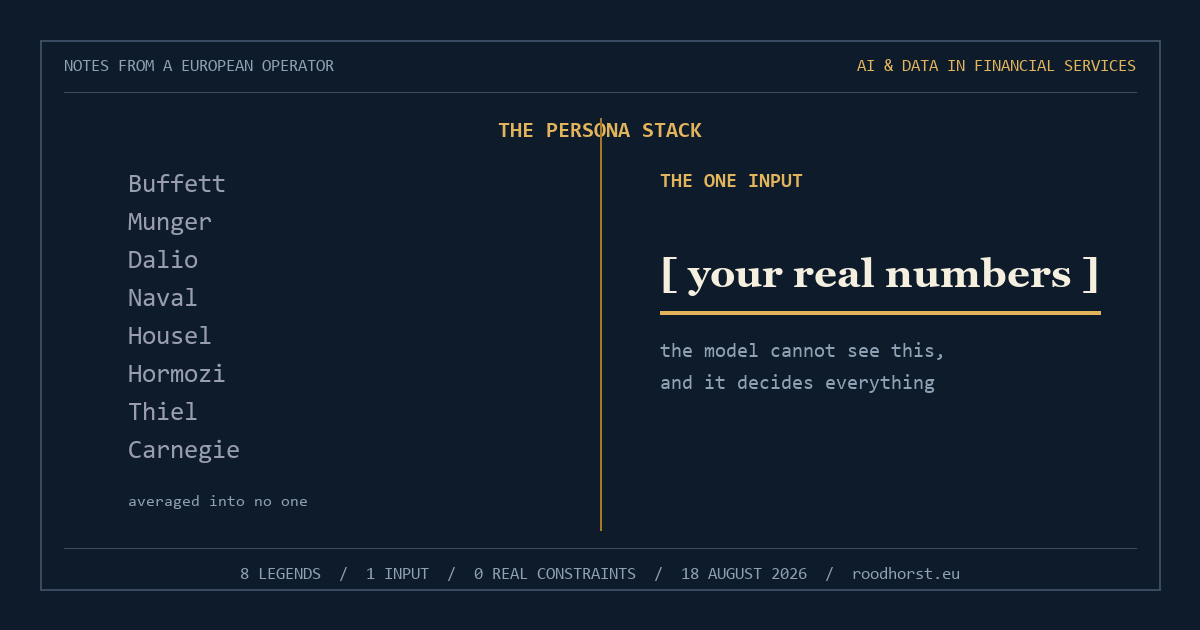
Stacking eight famous names does not summon their judgement. It averages their clichés. Those eight people do not agree with each other, and the disagreement is the whole point of each of them. Buffett built his fortune on ferocious concentration; half the others preach diversification. Housel’s entire body of work is a case for patience and mostly doing nothing; Hormozi’s is a case for speed and volume. Thiel wants you to find the secret nobody else believes; Munger just wants you to avoid being an idiot. Blend all eight and you do not get the wisdom of eight investors. You get a beige composite that offends none of them and channels none of them either.
Real judgement is the choice between those people for your specific situation, not a smoothie made of all of them. The prompt hands you the feeling of having convened a council while quietly deleting the one thing a council is for: a point of view.
The tell is “as quickly as possible”
Read the mission line again. “Multiply my wealth as quickly as possible.” That is not the language of anyone on the list. It is the language of the person writing the prompt, and it quietly biases every downstream phase toward the fastest visible win. It is why Phase 4 reliably produces “ten ways to make money with AI” and never “hold a low-cost index fund for thirty years and touch nothing.” Speed is the enemy of the compounding that the prompt’s own patron saints spent their lives defending.
I recognise the instinct, because I used to run on it. I came into European asset management from years in aggressive B2C performance marketing, where “ten ways to make money this week” was not a slop headline, it was the job description. Optimise for the fastest measurable win, ship it, do it again tomorrow. That world taught me real skills I still use. It also taught me a reflex this industry gently corrects: the money that lasts here is made in the structure you build and the constraints you respect, and structure is boring to prompt. You cannot screenshot compounding.
The one input a prompt cannot fake
Look at Phase 1, the diagnosis. Age, profession, income, assets, debts, risk profile, and then the placeholders: [AGE], [INCOME], [ASSETS], [DEBTS]. That is where the honesty leaks out. The model has no access to your real numbers, no duty to you, and no way to check what you type. It will build a risk profile from one optimistic line and hand it back with the borrowed authority of eight legends attached. It feels personalised. It is pattern-matched.
A prompt can borrow eight reputations. It cannot borrow your numbers. The diagnosis is the entire ball game, and it is the one phase no model can do for you, because it runs on inputs only you have and only you can be honest about. Filling [ASSETS] in truthfully, sitting with what the debt actually costs, naming the habit that quietly drains the account each month: that is the work. The council is set dressing around it.
The same prompt runs through our marketing stacks
Here is why this matters for anyone doing AI work in financial services, not just someone chasing a wealth plan. The exact same move is everywhere in marketing now. “Act as a world-class CMO combining the minds of David Ogilvy, Gary Halbert, and Alex Hormozi, and build my go-to-market strategy.” Borrow a stack of reputations, skip the diligence, receive confident output that sounds like strategy and contains none of your actual constraints. Not your compliance reality, not your channel, not your market, not the fact that you sell through Belgian banks rather than a US landing page. The persona is loud. The diligence is missing.
The fix is the same in both worlds, and it is not “stop using AI.” It is the opposite. Keep the scaffold, drop the theatre. The value of a prompt like this was never the council; it was the questions. Those seven phases are a genuinely useful diagnostic worksheet. Answer Phase 1 yourself, honestly, with your real figures or your real market. Then delete the eight names. What is left is a model helping you think in order, which happens to be the thing it is actually good at. That is the practical version of what AI actually means for European financial services marketing.
Every AI tool we adopt this year arrives dressed as authority: a stack of famous names, a confident structure, an output that sounds like judgement. The operator question is the same each time. Strip the borrowed reputations away, and is there anything underneath that knows your actual numbers? If you have built a prompt that survives that test, I would genuinely like to see it. I am at victor@roodhorst.eu, no form to fill in.
Sources & method
- The prompt text quoted in this note, as circulating the week of 18 August 2026.
- The 762-article public test lab – the published experiment behind the structure-over-theatre argument.
- What AI actually means for European financial services marketing – the wider context for AI prompt use in FS marketing.
- About Victor – operator background and method.