Notes from a European Operator · 25 August 2026
Banks own the most trusted distribution channel in European finance and the strongest customer-acquisition evidence in retail banking, and most of them do not run a referral program. The reason usually given is compliance. The evidence says the objection is a boundary, not a blanket.
The channel banks already own
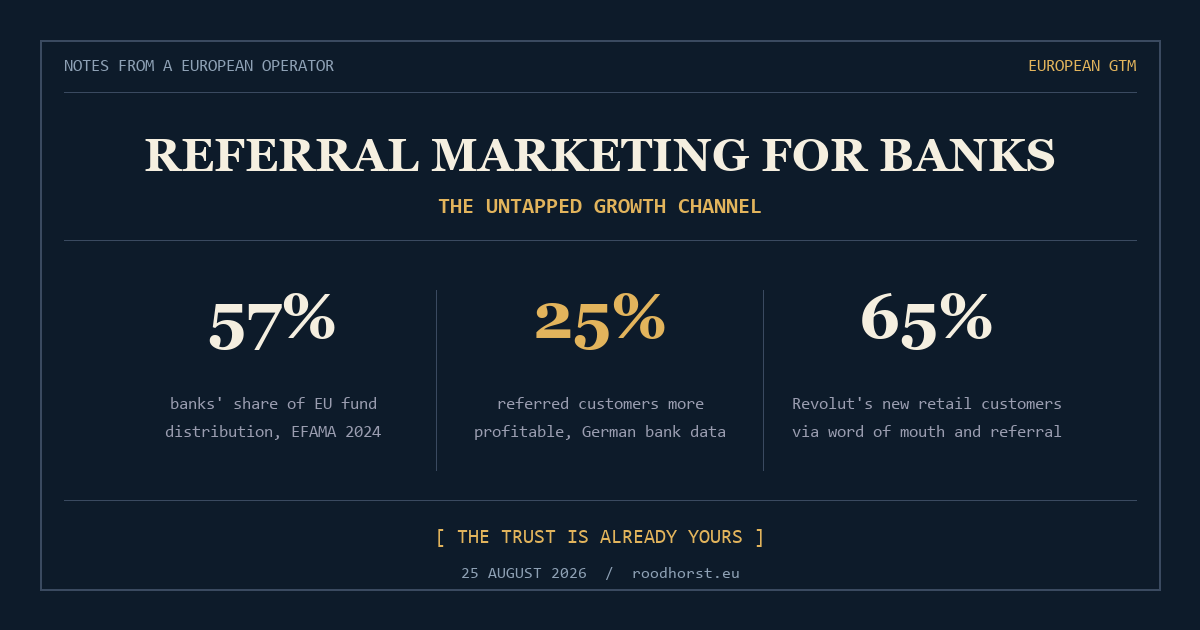
Referral marketing for banks is the rare growth channel where the evidence, the market position and the economics all point the same way, and the industry still treats it as a fringe tactic. EFAMA’s Market Insights 16 shows banks hold 57% of fund distribution in the European Union, and 45% across Europe including the United Kingdom, measured across 19 countries and EUR 4.4 trillion of retail fund assets. Banks are the default financial interface for most Europeans: the current account, the card, the savings product, the mortgage, often the fund sale. Distribution runs through them, and the trust that distribution is built on runs through their customers.
That trust is the referral asset. A bank referral is not a cold lead from a rented list. It is one customer telling another, in their own words, that the bank worked for them. The referral channel converts that existing trust into acquisition, at a cost per customer that paid media cannot match, and it is the one channel a bank does not need to buy. This is the untapped part of a distribution position banks already dominate. The argument fits inside the wider distribution story I have been building in the 5-layer distribution engine for European financial services: the bank channel is the shelf, and referral is the salesperson standing on it.
What a German bank’s own data says
Referral is one of the few acquisition channels in retail finance with a controlled academic result, and the result comes from inside a bank. Schmitt, Skiera and Van den Bulte tracked roughly 10,000 customers of a leading German bank for 33 months. The referred customers were about 25% more profitable than customers acquired through other channels, with higher contribution margins and higher retention, which together produced a higher customer lifetime value. The effect was strongest among retail customers and younger customers, exactly the segments where banks run their highest-volume acquisition.
The study is fifteen years old and the banking stack has changed, but the mechanism has not. Referred customers arrive with a better match: someone told them what the bank is like, so they are less likely to churn and more likely to use the product. There is a social stake too. Most people do not recommend a bank they expect to disappoint a friend. That selection effect is the economics, and it is why the same reward budget buys a better customer through referral than through a banner.
Why this compounds for banks
The effect becomes structural when you put it next to distribution. EFAMA’s report covers EUR 4.4 trillion of retail fund assets, and its own language is blunt about the role banks play in getting those funds to investors. Challengers have already built their growth on the same mechanic. Revolut reports that around two-thirds of new retail customers arrive organically or by referral, per Bullhound’s 2026 analysis of the company. Nubank reported that 80% of its signups came from unpaid referrals as it passed 25 million customers in 2020. These are not fintech tricks. They are the same trust mechanic banks already hold, run at scale, because the challengers had no branch network to lean on and referral was the cheapest distribution they could build.
Banks have the opposite profile: they hold the trust, the product range and the distribution, and they leave the referral mechanic to the challengers. The gap between them is risk, and the risk has a one-word name: compliance.
The compliance objection, unpacked
Ask a bank marketing team why they do not run referrals and you get the same answer in every market: compliance will never approve it. That answer is usually borrowed from rules that do not cover the product in question. The compliance objection is real, and it is product-scoped. Map the boundary and most of banking sits on the safe side of it.
The investment boundary. The inducement ban under MiFID II covers firms providing investment services and advice to clients, and it is enforced. The Dutch AFM fined neobroker BUX EUR 1.6 million for paying existing customers, comparison websites and finfluencers to introduce new customers, and the UK FCA bans refer-a-friend bonuses for high-risk investments and, since October 2023, for crypto. Those are investment products. A current account is not a designated investment, and a referral reward attached to one is not an inducement under those rules.
The credit boundary. The other real boundary is consumer credit. The recast Consumer Credit Directive, Directive (EU) 2023/2225, applies to credit agreements from 20 November 2026. It tightens advertising and conduct rules and gives member states an explicit option to restrict commissions paid by creditors to credit intermediaries. If your referral reward sits on a card or a loan, legal is in the room. If it sits on deposits, payments and current accounts, it does not apply.
The data boundary. The third objection is GDPR, and the ICO’s guidance on refer-a-friend schemes is precise about where the problem lives: firms harvesting friends’ contact details and mailing them without consent. The fix is design, not abandonment. The referrer sends the message themselves, with control over how it goes out, and the bank never processes the friend’s data until the friend chooses to act.
European finance is also adding new marketing rules faster than teams can track them, from the AI Act’s Article 50 transparency obligations to the conduct rules above. I have been tracking what applies to marketing teams, most recently in this edition on AI Act marketing transparency. Referral programs are not exempt from that trend. They are easier to design for than most teams assume, because the boundary is narrow.
What the challengers did
Every serious European referral program I have found shares the same DNA: the reward is tied to a behaviour that predicts a real customer, not to a signup.
Boursorama built parrainage into the product. Customers send invitation e-cards from their client area, up to fifty of them, and the mechanics were part of the engine behind the French online bank’s run past one million clients in January 2017. Referral was not a campaign bolted onto the bank. It was a feature of the client area.
N26 pays for behaviour, not for signups. The referrer is paid only after the new customer completes a qualifying first card transaction worth at least the bonus: a EUR 25 reward requires a EUR 25 purchase. Lifetime referral income is capped at EUR 1,500 and the bonus lands within 60 days. The gate kills fraud and rewards activated customers, not accounts that will never transact.
bunq ties every reward to funded activity. EUR 100 when a friend activates the Switch service in the Netherlands, a free Metal card after a EUR 50 card payment, EUR 50 bonus interest when a friend deposits EUR 1,000 into savings. Each reward exists because a specific behaviour happened.
Qonto proves it works in business banking. The French SME bank pays EUR 80 to the referrer and EUR 80 to the referee, but only after the referee’s first paid month. A referral program is a paying-customer channel, and the payout tracks the payment.
Trade Republic runs its referral as a regulated promotion. The reward can be cash or a fractional share, a single referrer is capped at 40 new customers, and selling the bonus is restricted for 90 days. It is inducement-aware design running inside an investment product, which is exactly where the boundary is tightest.
None of these programs is a compliance accident. Each one answers a specific objection with a specific mechanism: a quality gate against fraud, a cap against abuse, disclosure against mis-selling, referrer-controlled messages against GDPR. That is the pattern a bank should copy, not the reward amounts.
Design rules for a bank that wants to run this properly
If the evidence and the boundary are both clear, the design work is simple to describe and harder to keep honest. These are the rules the programs above follow, stated as a checklist.
1. Reward the behaviour that predicts a good customer, not the signup. First card transaction, funded deposit, first paid month. A signup reward buys accounts. A behaviour reward buys customers.
2. Cap and control everything. N26 caps lifetime referral income at EUR 1,500. Trade Republic caps one referrer at 40 new customers and restricts early sale of the bonus. Publish the payout window, the eligibility and the clawback conditions in plain terms.
3. Keep the referrer in control of the message. The customer sends the invite from their own app, mail client or messenger. The bank does not hold a list of the invitee’s contacts and does not send on the customer’s behalf. This is the GDPR design, and it is also better marketing: the message arrives from a person, not from a bank.
4. Disclose like a financial promotion. The reward is a marketing incentive. State the amount, the conditions, the tax and account-eligibility caveats, and the fact that no product is being endorsed by the referrer’s employer or by the bank itself. Fair, clear and not misleading is the standard in every EU market.
5. Start where the boundary is clean. Current accounts, payments, deposits and cards come first. Credit and investment lines come later, and only after legal has mapped the national rules, because that is where CCD2 from November 2026 and the inducement bans bite.
6. Measure the economics you get. Cost per paying customer after 90 days, 12-month retention, and lifetime value against your paid-acquisition benchmark. The German bank result is a planning assumption, not a headline: use it to size the pilot, then report what your customers did.
The referral compliance map
| Product line | What the rules say | Status |
|---|---|---|
| Current accounts and payments | Outside the MiFID II inducement rules; fair promotion and referrer-controlled messaging apply | Clear to run |
| Savings and deposits | Same boundary; disclosure and financial-promotion rules apply | Clear with disclosure |
| Consumer credit (cards, loans) | Consumer Credit Directive (EU) 2023/2225 applies from 20 November 2026; member states may restrict intermediary commissions | Legal review required |
| Investment services and advice | Inducement ban under MiFID II; refer-a-friend bonuses banned for high-risk investments and crypto in the UK | Restricted |
National rules differ, and this table shows the shape of the boundary, drawn from the sources below. If you are a compliance officer reading this and the map is wrong for your market, I would like to hear where: the point of the exercise is to make the boundary visible, not to wish it away.
Run this before you launch
Which product line carries the reward?
If it is investment services or advice, stop and get legal involved before designing anything. If it is deposits, payments or a current account, the inducement rules do not apply and the program can be designed like any regulated promotion.
Who sends the message?
The referrer must control how the invite goes out, from their own app or messenger. The bank must not harvest the invitee’s contact details or send on the customer’s behalf. That is the GDPR boundary and it is also what keeps the message human.
Is the reward conditional on real behaviour?
First card transaction, funded deposit, first paid month. If the reward is paid on signup alone, fraud and abuse follow, and the customers you acquire are the ones least likely to transact.
Is the promotion disclosed and capped?
Reward amount, eligibility, payout window, caps and clawbacks in plain terms, visible before the friend signs up. A referral program that reads like a financial promotion on the customer side is a referral program compliance can approve.
I have run referral and appreciation programs and seen what they do to acquisition economics when the reward is tied to real behaviour. My referral work at IG Group was featured by Buyapowa, the referral platform, so this is not theory for me, it is a channel I have operated. Referral works in banks; the German bank data says so. The question worth answering is whether the compliance objection in front of you applies to the product line you are marketing, or was borrowed from the one next to it. If you are running a pilot and want a second set of eyes on the design, I am at victor@roodhorst.eu, no form to fill in.
Sources & method
- Schmitt, Skiera and Van den Bulte, “Referral Programs and Customer Value” – Journal of Marketing, 2011. The German bank study: about 10,000 customers, 33 months, referred customers around 25% more profitable.
- EFAMA, Market Insights 16, “Investment fund distribution channels in Europe” – April 2024. Banks hold 57% of EU fund distribution, 45% across Europe, across 19 countries and EUR 4.4 trillion of retail fund assets.
- AFM, fine decision on BUX B.V. – November 2024. EUR 1.6 million for payments to existing customers, comparison websites and influencers under the inducements ban.
- FCA, “FCA clamps down on marketing of high-risk investments to consumers” – January 2022. Refer-a-friend bonuses for high-risk investments banned.
- FCA, “FCA introduces tough new rules for marketing cryptoassets” – June 2023. Refer-a-friend bonuses banned from October 2023.
- Directive (EU) 2023/2225, Consumer Credit Directive recast – applies to credit agreements from 20 November 2026; member states may restrict commissions paid by creditors to credit intermediaries.
- Foot Anstey, “What do you need to know about the ICO’s latest guidance on refer-a-friend schemes?” – July 2023. Referrer-controlled messaging under PECR and UK GDPR.
- N26, “How to earn money by inviting friends to N26?” – qualifying first card transaction, EUR 1,500 lifetime cap, 60-day payout.
- bunq, “Refer a friend and earn rewards” – rewards tied to Switch activation, card payments and savings deposits.
- Qonto, referral campaign terms – EUR 80 to referrer and referee after the referee’s first paid month.
- Trade Republic, refer-a-friend terms – cash or share reward, 40-referee cap, bonus sale restrictions.
- Bullhound, “Revolut: The Dawn of Modern Banking” – 2026. Around two-thirds of new retail customers arrive organically or by referral.
- Fintech Futures, “Nubank soars ahead with 25m customers” – 2020. 80% of signups from unpaid referrals.
- Boursorama Banque, press release, 17 January 2017 (PDF no longer online) – 17 January 2017. Parrainage e-cards from the client area, up to fifty per referrer, as the bank passed one million clients.
- Buyapowa, featuring Victor’s referral work at IG Group – the operator proof behind this piece (LinkedIn, login required).
- About Victor – operator background and method.
Method: every figure in this note links to its source. Where a claim is interpretation rather than data, for example the mechanisms in section 02, the text says so. The compliance map is a summary of the sources above for marketing planning, not legal advice.