Notes from a European Operator · AI Asset-Manager Observatory · No. 1 The current Index reading is the quarterly edition of this cut.
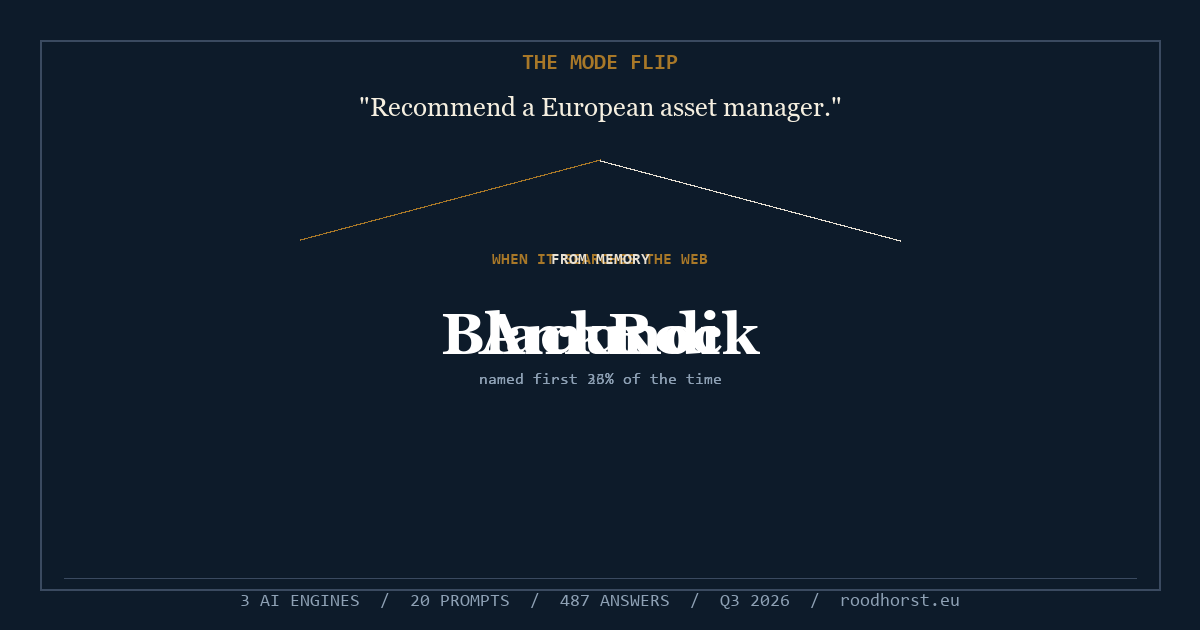
The same question, twenty prompts, 487 answers. When the engines searched the web they named BlackRock first. From memory, they named Amundi. The mode tracks with the winner: grounded engines searched and named BlackRock first, recall engines answered from memory and named Amundi.
I typed “recommend a European asset manager” into an AI chat. Then I changed one thing the question never mentioned: whether the engine searched the web before answering. The winner changed with it.
Across 487 answers and three engines in the English base run, the grounded engines that search the live web named BlackRock first. The recall engines answering from memory named Amundi. Same question, opposite winner. This is the first finding of the AI Asset-Manager Observatory, and it changes how asset managers should read every AI mention they track. The full divergence across all 487 answers is in the observatory deep dive.
The test
I asked the same question 487 times, in two modes
Last week I did what a prospect of one of my clients now does before opening a league table. I asked an AI engine to recommend a European asset manager. Then I asked again, and again: three engines, twenty ways of phrasing the same ask, 487 answers in total, the English base run.
The engines were chosen to carry the two modes. Gemini 2.5 ran grounded, with web search on. Mistral Large and DeepSeek ran in recall, with search off, answering from what they already knew. Every answer was logged, and every firm mentioned was matched against a frozen roster of 104 names. The full method and dataset are in the study itself.
Two details matter before the numbers. Every prompt asked specifically for a European manager. The question never changed. The caveat, in one line: in this run each mode ran on different engines, so mode and engine identity are not yet fully separated.
The finding
Grounded engines name BlackRock. Recall engines name Amundi.
When the engines searched the live web, BlackRock was named first 33% of the time, Amundi 22%. When they answered from memory, the order reversed: Amundi first 26%, BlackRock 18%. Not a different runner-up. The winner changed.
| Mode | Engine behaviour | BlackRock first | Amundi first |
|---|---|---|---|
| Grounded | Searches the live web | 33% | 22% |
| Recall | Answers from memory | 18% | 26% |
The overall leaders barely move. Amundi appeared in 72% of all answers, BlackRock in 67%, DWS 57%, Schroders 49%. The mode tracks with who is first, not who is in the conversation. Both firms are always present. Which one leads moved with whether the engine searched, in this run.
Same question, opposite winner. In this run, the winner moved with the mode, not with the firm.
That is the base run. The September 2026 re-read widens the panel to 2,243 answers, nine engines and five languages, and it narrows the claim instead of repeating it. Amundi now leads on reach in both modes in every language except one: in Dutch recall, BlackRock takes the lead at 65.7% against Amundi’s 63.5%. So the honest version of the finding is that memory rewards the brand the machine already knew, that this is most visible where the local brand is strong, and that the wider panel does not reproduce a universal swap. The flip chart in the Index shows the whole board in both modes.
The operator read
A recall advantage expires the moment the engine searches
A grounded engine can only name what it can find and cite. A recall engine can only name what it absorbed. Those are two different distribution channels with two different entry requirements, and the data says firms can win one and lose the other. The citation layer decides who gets cited and why.
If your firm is named from memory but not when the engine searches, you hold a recall advantage with an expiry date: the moment your prospect’s engine goes online. If you win the grounded question, your firm is findable, citable and structured where the engines look. That is the difference between being recommended and being remembered.
The same gap shows up in geography. Every prompt asked for a European manager, and 18% of all mentions in the base run still went to non-EU giants, with BlackRock in the top four and Vanguard in the top ten. US firms win a European question because grounded engines can find and cite their indexed, structured content. AI share of voice is a distribution metric, and the engine is a distribution channel. It belongs in the same distribution operating model as every other channel.
If the engines cannot read your site at all, neither mode can help you. The companion study on AI crawler rules at 105 European financial firms shows how many sites fail that test before the recommendation question is ever asked.
The operator question
Which mode are you losing?
Most firms track AI mentions without splitting them by mode. That hides the finding: you can be winning one channel and losing the other and never see it, because the averages look fine.
Run the split yourself. Take the ten prompts from the study method, ask them with search on and with search off, and compare the winners. If you win only from memory, treat that as a grounded-mode gap, not a victory. The live dashboard makes the flip visible on every firm: open the flip and watch the bar swap sides.
Operator’s memo
The engine’s mode is a distribution channel. Treat it like one, or the answer you never see is the one your prospect sees first.
Availability
Not taking new engagements The studies and the library stay open, and questions about them get an answer.
The mode split behaves differently in each language, and Dutch is the clearest case of it. Where the memory engines reorder the board shows which firms fall and which climb when the same prompt meets a different kind of engine.
The market-weight gap shows how the two lists diverge when measured against reported AUM, and who AI names for a European question is the US-giants note. If you want the flip measured for your own firm, that is the AI visibility audit.
1 thought on “Why AI Recommends a Different Asset Manager When It Searches”