Notes from a European Operator · AI Asset-Manager Observatory · No. 2 The European-vs-US split, measured across the full run, is in the Observatory.
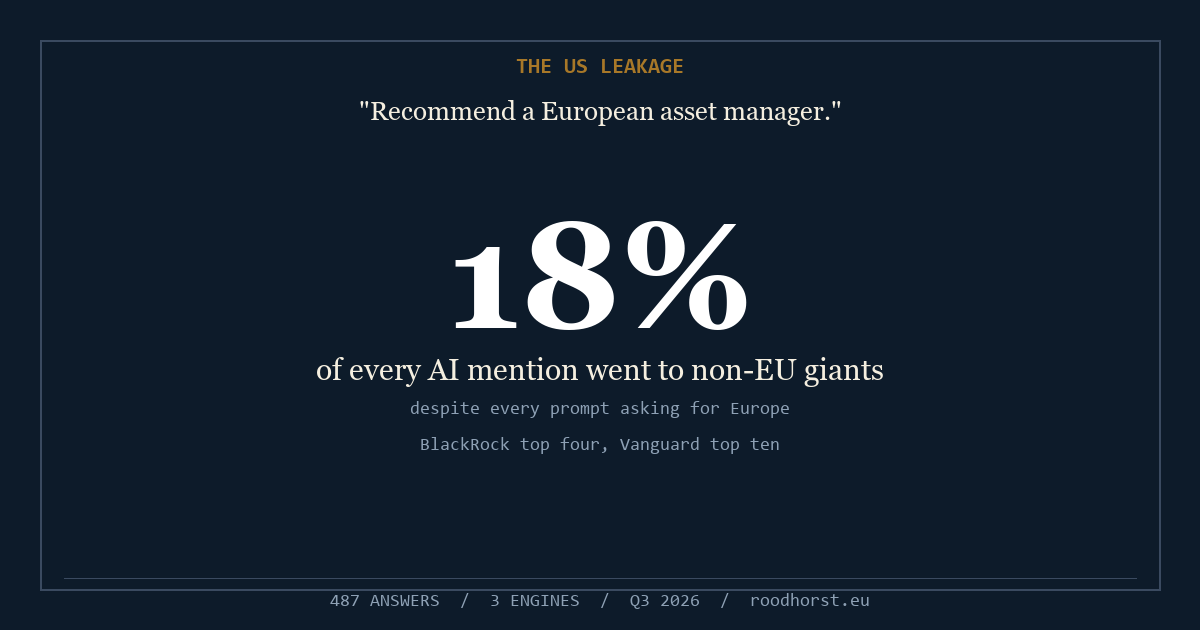
Every prompt asked for a European manager. Nearly one in five mentions still went to US giants: BlackRock in the top four, Vanguard in the top ten. The leakage is a content gap, not a quality gap. And it flips by language, as the multilingual cut shows.
Last week I asked three AI engines to recommend a European asset manager. Twenty different phrasings, all explicitly European: “a European asset manager”, “European asset managers”, “a manager based in Europe”. Four hundred eighty-seven answers, 104 firms named, every mention tagged by headquarter country.
The mode-flip note explains why the winner changes when the engine searches.
The result is not what the prompts asked for. Eighty-two percent of all mentions went to European firms. Eighteen percent went to non-EU giants, with BlackRock in the top four and Vanguard in the top ten. The second most-named manager overall, BlackRock at 67% of answers, is American. The question said Europe.
The test
I asked for Europe 487 times. The engines kept naming America.
| Origin | Share of mentions | Leading names |
|---|---|---|
| European managers | 82% | Amundi, DWS, Schroders |
| Non-EU giants | 18% | BlackRock (top four), Vanguard (top ten) |
This is not a rounding error or a prompt quirk. It survived every phrasing, and it is the same shape across the whole dataset. The full league table is live, and the US tag sits on every American firm: open the dashboard and filter the table by origin.
The why
Grounded engines name what they can find, not what deserves to win
The engines that search the web can only name what they can find and cite. The engines answering from memory can only name what they absorbed. The US giants are not in the answer because they are better managers. They are in the answer because they are easier to find, easier to quote, and structured for machines.
BlackRock’s content is indexed, cited and quotable everywhere. Its pages answer the exact question, its data is structured, and AI crawlers can read it. On the European side, the companion study on AI crawler rules at 105 European financial firms found a large share of sites that AI crawlers cannot read at all. If the engines cannot read your site, you are not losing on quality. You are not in the game.
AI share of voice is a distribution metric, and the engine is a distribution channel. When a European question gets an American answer, that is an import into a market you operate in. It belongs in the same distribution operating model as every other channel. The metric itself is defined in What Is AI Share of Voice in Asset Management?
The fix
The gap is content, and content is fixable
The leakage is not a brand problem. It is a findability problem, which means it has a mechanical fix:
- Be readable. Ship llms.txt, keep a clean robots policy, and do not let bot blocks sit on the pages engines cite.
- Be quotable. Publish the numbers in crawlable text, phrased as standalone claims an LLM can lift with attribution.
- Be the answer. Publish the page that answers the exact question, “which European asset manager”, with data.
The AI Asset-Manager Observatory is the working example: it is a primary source, its numbers are quotable, and it gets cited because engines can find and lift it. The full study and method show how the dataset was built and validated.
The fix is not advertising. It is becoming the answer the engine can cite.
The operator question
When AI answers a European question with a US firm, whose gap is that?
Before the next AI visibility report, split your mentions by the question asked. If your firm appears for its own name but not for the European question, the gap is the one this data shows: your content is not where the engine looks when it searches.
Run the split yourself on the dashboard, then ask whether a US firm is answering your market’s questions because your content is easier to replace than to cite.
Operator’s memo
Europe is not losing AI recommendations to America. It is losing them to content that is easier to cite.
Availability
Not taking new engagements The studies and the library stay open, and questions about them get an answer.
That leakage is one cut from a wider reading. The same twenty prompts, run across nine engines and five languages, show the board moving with the language and with the engine mode: the nine-engine index behind this finding carries the full per-market board and the rank changes inside it.
The market-weight edition shows the market side: BlackRock is also the largest manager of European institutional assets.
The same reading for one firm, against the managers it competes with, is the AI visibility audit.
2 thoughts on “AI Names US Giants When You Ask for a European Asset Manager”