Outside the Observatory cluster, the closest neighbour is the AI crawler audit.
Notes from a European Operator · AI Asset-Manager Observatory · No. 4
AI share of voice is how often a machine names your firm when someone asks for a recommendation. It moves before your traffic does, and almost nobody measures it. See share of voice measured across the full base run.
AI share of voice is the share of AI answers in which your firm is named when someone asks for a recommendation. It is a measurement of the moment before the website visit: the shortlist the machine hands the buyer.
The answers are in the short list of who actually shows up.
The definition
AI share of voice is how often the machine names you, at the moment of recommendation
The behaviour is now normal. Fund selectors, advisers and retail investors open ChatGPT, Gemini or Perplexity before they open a league table. The AI’s answer is the new shortlist. AI share of voice measures what that shortlist says about your firm.
It is not the same as brand awareness. It is not the same as web traffic. It is the moment in between: the machine deciding, on the buyer’s behalf, who is in the conversation at all.
The leading indicator
It moves before your website traffic does
Website traffic measures what happened after a decision point. AI share of voice measures the decision point itself. A firm that is not named is not clicked, not visited, not shortlisted.
That is why the metric matters to marketing teams: it is the earliest number that can move. A change in what the engines say today becomes a change in traffic and pipeline later, on the lag that search traffic used to have and no longer fully does.
The measurement
Reach, first place and mode: the three numbers that matter
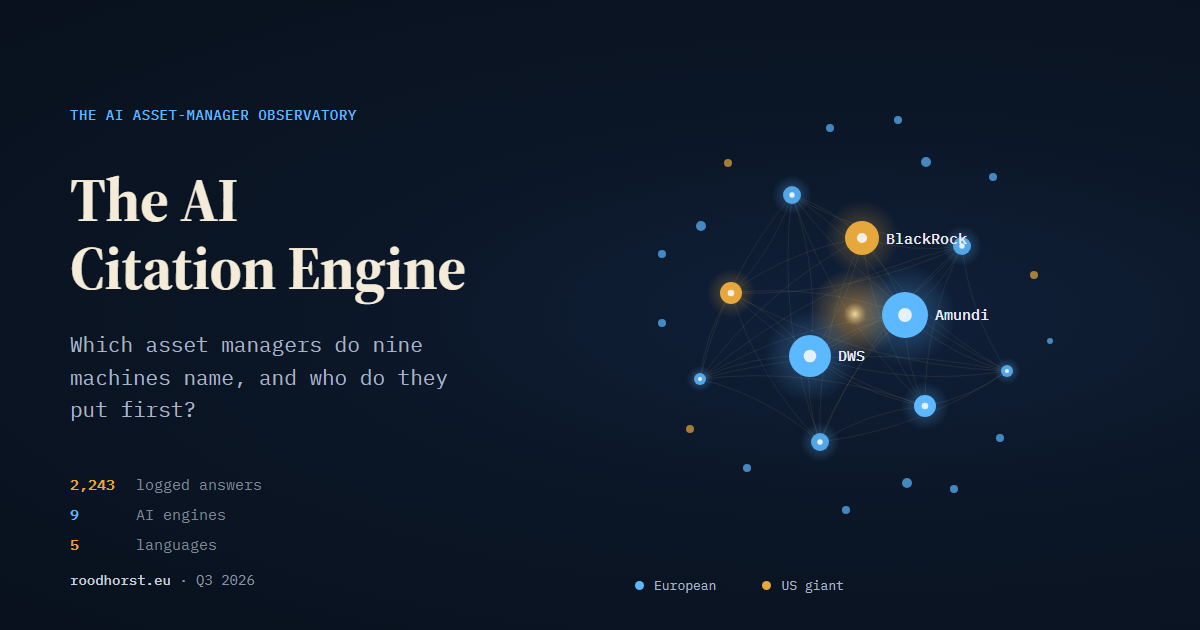
- Reach. The share of answers that name the firm. Amundi leads at 72%.
- First place. The share of answers that name the firm first. The winner changes with the engine’s mode.
- Mode. Grounded engines that search the web versus recall engines answering from memory. Grounded engines named BlackRock first 33% of the time; recall engines named Amundi 26%. Same question, opposite winner: the flip.
The mode split is the strategic read, because the two modes have different entry requirements: a recall advantage expires the moment the engine searches. And the leakage is real: 18% of mentions went to US giants in a question that said Europe.
The full instrument is live: AI share of voice in asset management, with the league table, the flip and the movers, re-run every quarter. The study and method show how the data was built and validated.
If the board wants a scorecard rather than a single metric, the six AI visibility KPIs for asset managers split reach, accuracy and recommendation into six numbers.
The operator question
What is your firm’s number?
Run the twenty prompts from the study method, split the answers by mode, and compare reach against first place. If you do not know both numbers, you do not know which channel is broken.
If you are not measuring AI share of voice, you are guessing at the shortlist.
Operator’s memo
AI share of voice is the metric that moves before your traffic does. If you are not measuring it, you are guessing at the moment of recommendation.
Availability
Not taking new engagements The studies and the library stay open, and questions about them get an answer.
If the number is low, the fix is structural rather than budgetary: how to get your firm named when someone asks AI for a manager sets out the levers in order.
Sources & method
- The AI Asset-Manager Observatory: full study, method and dataset
- The live dashboard, flip section
- Why AI Recommends a Different Asset Manager When It Searches
- AI Names US Giants When You Ask for a European Asset Manager
- AI Citations for Asset Managers: Who ChatGPT Cites, and Why
- AI Share of Voice vs Brand Pull: The Outliers