Notes from a European Operator · AI Asset-Manager Observatory · No. 3 The league table behind this note is in the Index.
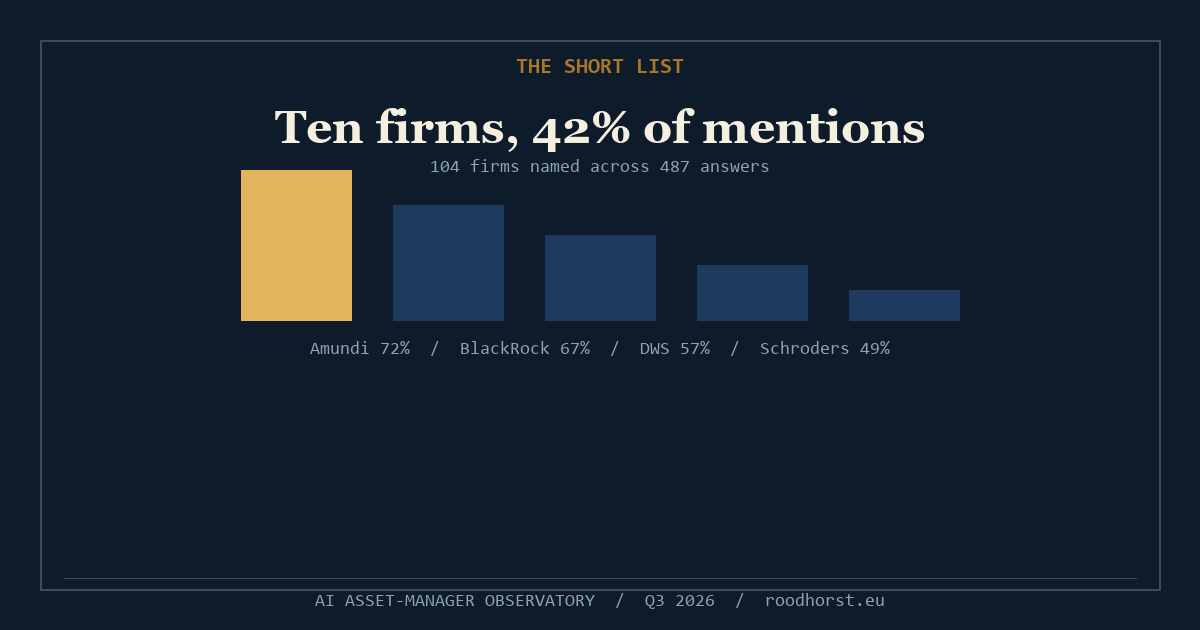
104 firms were named in 487 answers. Ten of them took 42% of every mention. AI has a short list of European asset managers, and it barely moves.
Last week I asked three AI engines to recommend a European asset manager, twenty ways of asking, 487 answers in total, the English base run. Every answer was parsed against a frozen roster of 104 names. The engines never ran out of firms to name. They just stopped varying.
The list is short. Ten firms soaked up 42% of every mention. Amundi appeared in 72% of answers, BlackRock 67%, DWS 57%, Schroders 49%. The field behind the leaders is thin: if you run a capable European manager that is not one of maybe fifteen names, the engines barely register you. The league table makes the drop-off visible row by row.
The numbers
The engines named 104 firms. Ten of them took 42%.
| Measure | Value |
|---|---|
| Distinct firms named | 104 |
| Firms holding 42% of mentions | 10 |
| Most-named manager (Amundi) | 72% of answers |
| Second (BlackRock) | 67% of answers |
| Third (DWS) | 57% of answers |
| Fourth (Schroders) | 49% of answers |
Ninety-four firms split the remaining share of voice. Most of them appeared in a handful of answers. That is the shape of the dataset: a dense head, a thin shoulder, and a long tail that barely registers, and brand pull vs AI pull explains who stays on top. It also explains what the metric is measuring: not popularity, but who the engine puts forward when the question is asked.
The September 2026 re-read makes the list tighter, not longer. Across 2,243 answers in the Index the engines still named 104 distinct firms, and the top ten took 47.7% of all mentions, with the top twenty at 67.8%. More answers did not spread the field. They thickened the same fifteen names.
The why
The shortlist is stable because the sources are stable
The engines converge on the same names for two reasons. Grounded engines cite the same indexed, quotable sources again and again. Recall engines reproduce the names strongest in their training data. Both mechanisms favour the already-famous, so the list barely moves between questions and between modes.
The long tail of European managers, the boutiques and the mid-tier houses that make up most of the industry, barely registered. Not because the data says they are worse. Because the engines never had a reason to look past the fifteen names.
This is the concentration problem behind every AI visibility report. The metric that matters is not whether you are mentioned. It is whether you are inside the shortlist, and the shortlist is built from sources, not from merit.
The operator read
For the long tail, being mentioned is the wrong target
If your firm is outside the fifteen, generic share of voice is the wrong game. Chasing it means measuring your distance to a list that does not move.
The play is owning one specific question. AI engines cite primary sources, so the firm that publishes the definitive data on one question becomes the answer to that question, regardless of its overall fame. Niche specificity beats rank thirty on a generic question.
That is exactly what the observatory does for the share-of-voice question, and it is why it gets cited: the study and method. The same pattern works for a firm’s own edge: a country, a channel, a product, a regulatory shift. And it compounds: the mode-flip finding, why AI changes its answer when it searches, is one observation pulled from the same dataset.
The engine is a distribution channel, and a shortlist is a shelf. The question is which shelf you are fighting for: the distribution operating model.
The operator question
Which question can your firm own?
Pick the one question only you can answer with data. Publish it as a primary source. Measure whether the engines cite it, not whether they rank you.
The shortlist will not expand for you. The sources the engines cite will.
Operator’s memo
AI does not have a long tail. It has a short list. Either you are on it, or you become the source the engines cite instead.
Availability
Not taking new engagements The studies and the library stay open, and questions about them get an answer.
The 42% is stable at the level of the set. The ordering inside it is not: replaying 600 answers across three engines in the English-cut replay, the first-place firm changed between runs in 48 of 60 cells, and one prompt produced eight different leaders in ten runs.
Concentration at the top of the list is not the same as control of it. The four levers that decide whether a firm is in the set at all, and the order to pull them in, are published with the underlying readings.
Concentration at the top of the set is stable. The measurement that shows whether a firm is moving inside it is not a ranking: the rate, the width and the language cut are the three things a share of voice report has to state.
The market edition adds the AUM layer: which of these firms actually owns the money. Your own position on that shortlist is measurable: the AI visibility audit scores one firm against its named competitor set, across five languages.