AI SHARE OF VOICE
Improving your AI share of voice is mostly plumbing. Across 105 European firms, 27,000 monitored ChatGPT answers and 1,732 multilingual runs, four things move a shortlist, and not one of them is a bigger content budget.
Your AI share of voice starts with a number that already exists. In the base run behind the Observatory, 487 answers across three engines named 104 asset managers, and the ten most mentioned of them took 42% of every mention. That distribution did not follow the largest brands. It followed the firms the engines could fetch, in the language the question was asked, on pages built like answers rather than brochures. So if you want to improve your number, the work splits into one measurement and four levers, and I can show you the evidence for each one.
Decide what the number is before you try to move it
The single most expensive mistake in this category is treating a shortlist position as a position. It is a rate. I replayed 600 saved completions, three engines by twenty frozen prompts by ten runs each, and in 48 of the 60 prompt and engine cells the first-place firm changed between runs. Only 12 cells held the same leader in all ten runs, and the average cell gave its most common winner 71.8% of its runs.
That finding, the repeatability study published this week, changes what improvement means. A firm that is named in four runs out of ten and then in seven has improved, even if the ranking graphic looks the same. A firm that jumps from fourth to first between two single readings has learned nothing about itself. So the target is membership across runs and engines, measured on a frozen panel, and everything below is a way to raise that membership.
The panel matters because the answers are not stable in the first place. In the same replay, only three of twenty prompts produced the same market leader across all three engines, and one prompt produced eight different leaders in ten runs. If you want the underlying readings, the frozen prompts and the firm roster live with the Observatory panel of 104 named firms, and they are the same inputs I use here.
Lever one: permission, which almost nobody manages
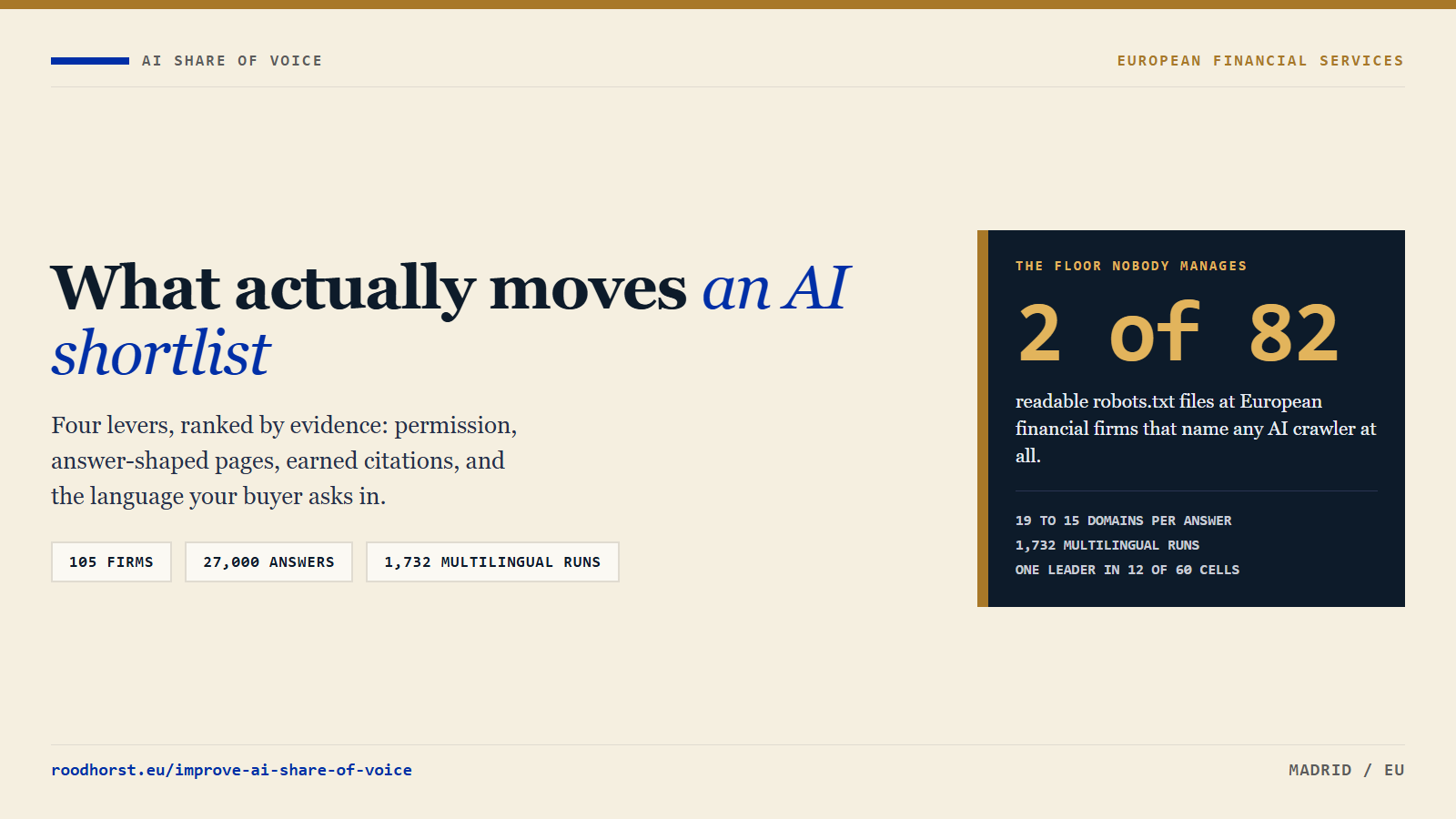
An engine cannot recommend a page it is not allowed to read. I audited the crawler rules of 105 European financial firms across 15 countries, and 82 of them served a readable robots.txt. Of those 82, two name an AI crawler at all. One blocks three of the five agents that decide whether an assistant can quote you today, and one names a crawler without blocking it. The other 80 write no AI-specific rule at all, so every agent inherits whatever the wildcard says.
The shape of that default is worth stating, because it is the cheapest lever on this list and it is not being pulled:
The second half of permission is not robots.txt. It is answerability. Ninety-three of the 105 domains serve nothing useful at llms.txt: 73 return an HTML page with a 200 status, which is a soft 404 dressed as a directory, and 20 return nothing at all. Twelve serve a real file. None of that is fatal yet, because the agents mostly ignore the file, but it tells you how much attention the average marketing function has paid to the machine-readable layer of its own site.
Fixing permission takes an afternoon and no budget. It is also the only lever on this list where the work is a one-time change rather than a running programme, which is why it is the first thing I check.
Lever two: get into a pool that is getting smaller
The set an engine draws from has shrunk. After OpenAI switched the default model behind ChatGPT search in March 2026, the average answer went from citing 19 unique domains to 15, a drop of about a fifth, measured across 27,000 comparable responses by Resoneo and Meteoria. Unique URLs per answer fell from 24 to 19. The ratio of URLs to domains held flat, so the engines did not start reading the surviving sites less deeply. They read fewer sites.
ChatGPT sources per answer, before and after 4 March 2026
Fewer slots with the same demand for answers is a simple equation. If your page was the sixteenth source in March, it is now competing for a place that no longer exists. That is the mechanism behind a lot of the movement firms see between quarterly readings, and it is the reason the shrinking citation pool is a distribution problem rather than a technical one.
Where the surviving slots sit is not uniform. The retrieval layer runs through pipelines with different appetites, and the difference decides how much of your page the model ever sees. In the licensed news and reference tier, records carry long excerpts, roughly 1,080 characters in the observed captures. In the bulk tier that covers most corporate and product pages, the model gets a title, a short snippet and a date. One pipeline hands over a paragraph. The other hands over a business card.
That single fact reorganises the content plan. Earned coverage in the licensed titles is not a brand exercise, it is the only route into the pipeline that carries sentences. And on your own pages, the unit that survives is roughly a headline plus a short paragraph, because that is what the snippet builder reads. Meta descriptions do not enter it at all. If the citable fact about your fund sits in paragraph twelve of a strategy page, the pipeline never carries it.
Lever three: own the entity surface you do not control
Ask an engine about European asset managers and a slice of the answer leaves Europe. In the base run, 18.4% of mentions on a European question went to firms outside the region. That leakage is not a ranking decision anyone made. It is what happens when the retrieval set is thin in the local entity and one clean, well-maintained page about a global firm is easier to lift than a scattered set of local ones.
The entity layer is where that gets decided, and you do not own most of it. A Wikipedia record in your category is a citation surface with a long excerpt attached. Trade press, ranking tables, association pages and directory entries do the same job at lower volume. All of them are read as third-party evidence about who you are, which is why they move a model more than your own homepage.
The tempting counterargument is size. It does not hold. Across the eight managers that matter most in this category, the correlation between AI reach and a brand-pull proxy sits at 0.34, and the splits run both ways: brand size does not buy a recommendation. Firms with a fraction of the assets of their peers appear in answers their peers miss, and the pattern tracks entity clarity and third-party presence more closely than it tracks advertising.
Lever four: the language your buyer asks in
I ran the same twenty questions in five languages and collected 1,732 answers: 591 in English, 342 in Spanish, 270 in German, 269 in Dutch and 260 in French. Europe held between 80 and 83% of the mentions in every language, so the regional composition is stable. The top of the list is not. The leading firm in Spanish was not the leading firm in English, and the Dutch reading put a different name first again.
This is the lever most European firms have not staffed. A firm with one English site competes in one of five queues, and it competes there against global managers with stronger English entity coverage. A firm with a German and a Dutch presence competes in three, and in two of them the leading names are different. The marginal cost of the second language is real, and it is usually smaller than the cost of the media it would take to shift the English reading by a measurable amount.
What does not move it
Volume does not. I generated 762 AI-assisted articles for my own site in sixty days and the year that 762 AI articles produced 31 clicks ended with a rebuild rather than a ranking. If a firm can produce unlimited pages, so can every competitor, and the retrieved set is shrinking rather than growing.
Budget does not buy it directly either. The 0.34 correlation above is the clearest version of that, and it survives every cut I have run. Paid media still does the job it always did, which is reach and demand, and it does not enter the retrieval layer that decides what a model says when a client asks for a manager.
And a single audit does not move anything. A one-off reading tells you where you stood on one day, in one engine, with one phrasing. Given that the leader changed in 48 of 60 cells, that is a photograph of a moving object.
The order I would run this in
Permission first, because it is free and it gates everything else. Then the pages that answer your buyers’ questions in a headline and a first paragraph, starting with the three or four questions that decide your category. Then the entity surface, which is a year of steady third-party work rather than a project. Then the second and third language, with the translations written for the question rather than turned from the English page. Alongside all of it, measure membership across runs on a frozen panel, and report the run count with the number.
| Lever | What it changes | The evidence | Who owns it |
|---|---|---|---|
| Crawler permission | Whether any of the rest is possible | 2 of 82 readable robots.txt files name an AI crawler | Technical and web, an afternoon |
| Presence in the retrieved set | What the snippet pipeline can carry, and how much of it | 15 domains per answer, and roughly 1,080 characters in the licensed tier against a business card elsewhere | Content, with comms |
| Entity surface | Whether the model can describe you at all | 18.4% of mentions on a European question go outside the region | Comms, with legal |
| Language | Which queue you are even in | 1,732 answers, five languages, different leaders | Nobody, at most firms |
Two of those four have no natural owner in a typical European asset manager. Entity work sits between comms, legal and the corporate site, and language sits between marketing and whoever owns the local entities. Those are the two where the shortlist is lost, and they are lost to nobody in particular. That is a much easier problem to fix than a brand problem, and it is why this work sits in the distribution stack rather than in a separate AI project.
The honest part
None of the four produces a chart that looks good in a board pack on its own, and I run them as a fixed sequence: open the door, fix the pages that answer questions, earn the citations, then add the second language. The measurement that tells you whether it worked is membership across runs, not a rank from one. What an audit on a frozen panel looks like sets out how I run that on your category.
Notes from a European operator
Ask anyone selling you AI visibility how many runs their number came from, then ask what their robots.txt says. If they cannot answer the second one, they are not managing the door, and nothing behind it counts.
Sources, data and method
- Observatory base run: 487 answers, three engines, twenty frozen prompts, 104 firms named, ten firms taking 42% of mentions, 18.4% of mentions outside Europe. Readings and method at the AI Asset-Manager Observatory.
- Repeatability: 600 saved completions replayed, 48 of 60 prompt and engine cells changed their first-place firm, 12 held one leader in all ten runs, mean 71.8%. Dataset and method in the repeatability study.
- Crawler audit: 105 firms, 15 countries, 82 readable robots.txt files, 2 naming any AI crawler, 20 fully open, 60 inherited path limits, 1 site-wide block, 12 real llms.txt files, 73 soft 404s. July 2026 run, firm-level dataset published.
- Citation pool: 19 to 15 unique domains and 24 to 19 unique URLs per answer, 27,000 comparable responses, March 2026 model switch. Resoneo and Meteoria, reported by Search Engine Journal in April 2026. Pipeline behaviour and the 1,080 character excerpt ceiling from Resoneo and Oncrawl, July 2026.
- Multilingual run: 1,732 answers (English 591, Spanish 342, German 270, Dutch 269, French 260), Europe holding 80 to 83% of mentions in every language.
- Brand pull: the reported correlation of 0.34 is between AI reach in the base run and English Wikipedia pageviews as a brand proxy, July 2026. Directional, and labelled as a proxy rather than a measure of brand strength.
- Limits: twenty prompts is a sample of buyer questions, robots.txt and llms.txt change without notice, and the audit snapshot is dated July 2026. Snippets and pipelines are undocumented and can change in any release, so every figure here describes the state of the system when it was measured.
The four levers move the number, and the number itself has to be built so you can tell movement from noise. The measurement method I run sets out the panel, the engines, the run count and the rate, so a quarter on quarter comparison means something.
2 thoughts on “How to Improve Your AI Share of Voice: What Actually Moves the Shortlist”