AI Share of Voice · Europe vs US
eMarketer ranks US brands by how often ChatGPT names them. That works for one engine, one language and one kind of buyer. I asked the same question across nine engines and five languages, and the machines disagreed with each other in ways a single-engine index cannot show.
AI share of voice in asset management has a public scoreboard now, and the most quoted version of it is American. eMarketer’s AI Visibility Index reads 5,600 ChatGPT recommendations a quarter across nine financial-services categories and reports which brands the model names most. In the Q2 2026 reading Capital One topped it, named in 19% of answers, with State Farm, Klarna, Ally and SoFi leading their own categories. That is careful work, and it answers a real question for a US consumer brand.
For a European asset manager it is a thin instrument. The buyer types the question in Dutch, German, French, Spanish or English. The product is a fund, not a credit card. And the engine on the other end may be Gemini reading the live web, or a model answering from memory with no web access at all. Those are not two ways of writing the same answer. They are two machines that return different shortlists for the same prompt.
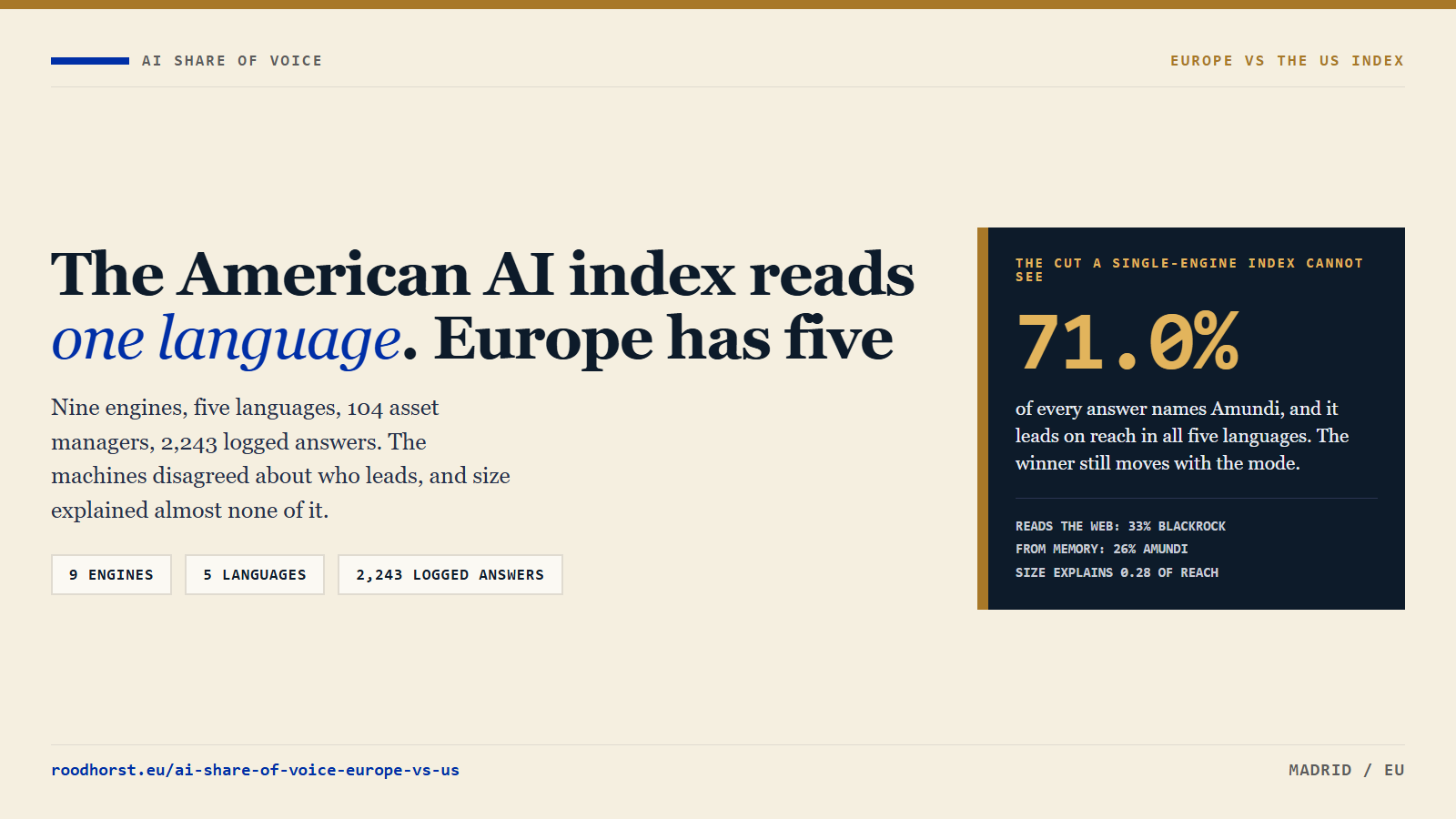
I ran the version Europe needs. Nine engines, five languages, the same twenty buyer-intent prompts, and a fixed roster of 104 asset managers with their aliases mapped. This quarter the Index holds 2,243 logged answers, every one archived. The disagreement between the engines is the story.
The American index holds three variables still
The US index fixes the engine, the language and the buyer, then reports who wins. For Capital One, State Farm and Klarna that is a fair trade. They sell to people who ask in English, on one engine, and the number holds still enough to compare two quarters.
Europe moves all three. Ask for a European asset manager and the answer depends on which engine you opened, which language you asked in, and whether that engine searched the web before it answered. An index that fixes the engine and the language describes one market, and Europe has five.
The leakage shows up even on a question with Europe written into it. Ask for a European manager and roughly a fifth of the names that come back are American. That is the American names that answer a European question, not a gap in the roster. The machines are not being lazy. They are answering from a memory that was built elsewhere.
Nine engines, one roster, twenty frozen prompts
The run is boring on purpose, because boring is what makes two quarters comparable. Twenty prompts written the way a buyer or an allocator asks for a manager, frozen and reused. The same 104 firms, 86 European and 18 global, with aliases mapped so a brand, a legal entity and a sub-fund label resolve to one row before anything is counted. Nine engines across both modes. Five languages.
The roster and every saved answer are archived at the Observatory, where the panel and the raw completions live, and the matching rules sit in the citation-engine method note. Freeze the panel, publish the prompts, keep the answers. A reading nobody else can check is a slide, not a measurement.
The same question returns a different board
Split the engines by how they answer and the board stops matching itself. In the English base run, the engines that searched the web named BlackRock first in 33% of answers and Amundi in 22%. The engines that answered from memory named Amundi first in 26% and BlackRock in 18%. Same prompt, same week, reversed order.
Dutch runs it the other way. The memory engines put BlackRock first on reach, 65.7% against Amundi’s 63.5%, and name BlackRock first 29 times to Amundi’s 22. Whichever direction a cut lands in, the winner is a property of the measurement before it is a property of the market. That is why the two readings sit in separate columns instead of being averaged into one comfortable rank.
One caveat travels with the split. In this run the grounded and recall readings come from different engine sets, so part of the gap is engine identity rather than mode. The cut is published apart for that reason, and the mode cut behind it is treated as a finding to test rather than a law.
The movement underneath the top spot is where it gets useful. Change the mode in Dutch and three firms drop: Allianz Global Investors from 8th to 14th, Comgest from 10th to 18th, Carmignac from 11th to 20th. Three others climb. Pictet moves up three places into the memory top four, and Nordea Asset Management and AXA Investment Managers gain seven and nine places.
Language is not a translation layer
European firms hold more than 80% of the mentions in every language measured: 83.2% in French, 80.9% in Dutch. Home advantage is real, and it is thinner than it sounds. Behind Amundi, the runner-up is BlackRock in every market except Germany, where DWS outranks the American firm on reach, 66.5% against 59.7%.
The winner is unusually clear. Amundi appears in 71.0% of all 2,243 answers and leads on reach in all five languages, from 77.4% in French and 72.5% in German down to 63.5% in Dutch. No other firm holds the top of the board in every market. That is what a firm looks like when it is legible to the machines in every language its buyers use.
A European manager with one English site competes in one of five queues, and it is the most crowded queue of the five. The five-language cut carries the full per-market board, and the number that matters in it is not the overall rank. It is whether the same firm appears in the same place when the question is asked in the language the client uses.
Size and fame buy very little
The assumption is that the largest firms get named. Across eighteen firms, assets under management correlate with AI reach at 0.53, and most of that rests on the two largest names. Take Amundi and BlackRock out and the correlation falls to 0.39. In the middle of the board, a trillion in assets buys nothing reliable.
Public profile is weaker still. Against Wikipedia pageviews as a proxy for fame, the correlation is about 0.35 across 33 firms. Being known explains little of who the machines recommend. Comgest, Robeco, Carmignac and Nordea surface the moment a question gets specific, next to managers many times their size.
The concentration is real, though, and it is the reason a boutique should care. The top twenty firms take 67.8% of all mentions, and the other 84 split the rest. That remaining third is not a rounding error. It is the part of the board a mid-sized manager can move into, and it is won on relevance rather than reputation.
What a European manager does with this
The scoreboard is the easy half. The question a head of marketing or distribution asks next is what moves a firm up, and the order matters because the three levers cost different amounts of time.
- Be readable by the engines that read the open web. Structured, sourced, current pages in each language you sell in, plus crawler access so the engine is allowed to fetch them. This is the fastest of the three and the one most European firms have left undone.
- Earn the third-party references the models trust. The coverage, citations and independent pages that decide whether you count as a European manager at all when the engine assembles an answer.
- Close the memory gap on purpose. Recall is a slower race and it rewards a consistent identity over quarters, not a campaign. It is where the American giants are quietly ahead and where the next two years get decided.
The execution detail on the first two sits in the four levers that move a shortlist, each with its own evidence. The firm-level version of this measurement, run against your named competitor set in your languages, is the same exercise run against your own competitor set. The number is also one input into a wider problem. Being findable is not the same as being distributed, and distribution is a five-layer operating model rather than a content project.
This quarter, for your firm
Run one prompt in two places. Open an engine that searches the web, and an engine that answers from memory, and ask each for a European asset manager in the language your clients use. Write down who gets named. If you appear from memory and not from the live web, the problem is your published surface. If you appear on the web and not from memory, the problem is slower and it is about consistency, not content volume.
Frequently asked
What is AI share of voice in asset management?
The share of AI answers that name a fund manager when a buyer asks an engine for a recommendation. This index measures it across 2,243 logged answers, 104 European firms, nine engines and five languages.
Which asset manager has the highest AI share of voice?
Amundi. It appears in 71.0% of all answers and leads on reach in each of the five languages measured, from 77.4% in French to 63.5% in Dutch.
Does size or assets under management predict AI share of voice?
Weakly. Assets under management correlate with AI reach at 0.53 across eighteen firms, and 0.39 once the two largest firms are removed. Public profile is weaker at about 0.35, so neither size nor fame explains most of who the machines recommend.
Why measure more than one engine and one language?
Because the answer changes with each. Engines that search the web and engines that answer from memory return different boards, and the same question in Dutch, German, French or Spanish produces a different order. A single-engine, single-language number describes a fraction of what a European buyer sees.
How often is the index updated?
Quarterly, against a fixed roster and a frozen prompt set, so two readings stay comparable. Every answer is archived so the number can be checked.
Notes from a European operator
Ask any visibility vendor one question before you buy: which language, which engine, and did it read the web. A number that cannot answer all three is describing somebody else’s market, and it is usually the American one.
Sources, data and method
- The AI Asset-Manager Observatory, Q3 2026: the 104-firm roster, the twenty frozen prompts, the alias rules and every archived answer.
- The citation-engine method note: how answers are collected, matched and counted, and what the validation gate rejects.
- The five-language cut: per-market boards and the 1,732-answer multilingual run, published separately from this nine-engine cut.
- Run behind this piece: Q3 2026, nine engines, five languages, twenty prompts, 104 firms, 2,243 logged answers. Reported beside, never merged with, the 487-answer base run.
- Correlations: assets under management against AI reach, r 0.53 across eighteen firms and r 0.39 excluding the two largest; Wikipedia pageviews against AI reach, r 0.35 across thirty-three firms. Correlation is not causation, and a thirty-three-firm sample sizes a signal rather than proving one.
- Limits: twenty prompts sample buyer questions rather than exhaust the set. Grounded and recall readings come from different engine sets in this run, so part of any mode gap is engine identity. Models change under a stable name, so a reading describes a quarter, not a permanent property. Nothing here rates a manager, a fund or a strategy.
1 thought on “The Americans measure AI share of voice in one language. Europe needs five.”