The measured version of the same work is the Index.
Notes from a European Operator
Most distribution functions run on relationships. Here is the operating model that replaces them, and a scorecard to rate your own in five minutes.
Every asset manager I speak to agrees that distribution matters more than it used to. Almost none have rebuilt the system underneath it. That gap is the whole opportunity, and it is the reason this piece exists.
What follows is not another argument that distribution is the new moat. This is the operating model itself: five layers that decide whether your commercial engine compounds or leaks, and a scorecard to rate your own function before you read another word of theory.
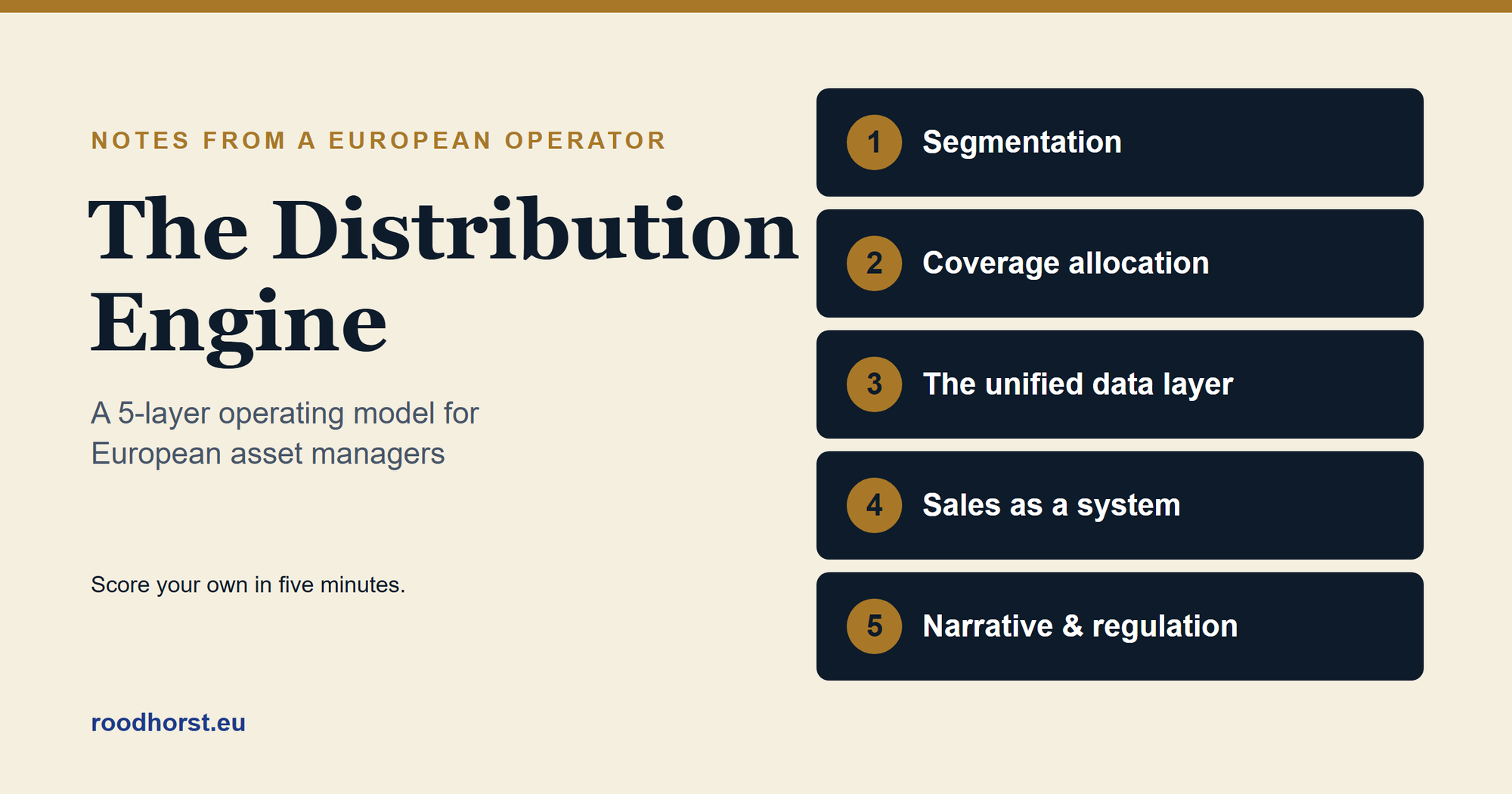
The distribution engine is a five-layer operating model: segmentation by wallet, coverage allocation, a unified data layer, sales as a system, and narrative and regulation. Each layer answers one question and fixes one common failure, and a weak lower layer caps the whole engine. The research this is built on is the AI Asset-Manager Observatory. The newest proof sits in the product names: European ETF names now average nine words, half of them boilerplate, measured across 4,080 listings.
Why most distribution functions are currently underperforming
In April 2026, BCG published the clearest diagnosis I have read of where value is migrating in asset management. Distribution has replaced investment performance as the primary competitive advantage. The uncomfortable part is BCG’s fieldwork on why most firms cannot capture it. Client segmentation is built around size, when most of the actual client base sits below that bar. Coverage is allocated by legacy relationship, not forward potential. Pitch prep, proposals, and follow-up still eat the hours that should move flows and is not freeing up time to work on the relationship building, which is how fund distribution works in Europe.
BCG names it correctly. It is an architecture problem, which we are suggesting to fix here.
The five layers
Think of distribution as an engine with five layers, from the foundation up. Each layer answers one question and fixes one common failure. A weak lower layer caps everything above it, which is why the order matters.
Layer 1. Segmentation by wallet, not legacy
Most segmentation encodes history. Clients are graded on the revenue they already produce, which quietly points your best people at yesterday’s winners. BCG’s finding is that most of the client base sits below the firm’s own segmentation threshold, which means the model is diluting focus rather than sharpening it. The fix is a half-day query: re-rank the base by forward wallet potential and see how many accounts move. In my experience it is usually about a third.
Layer 2. Coverage allocation
Once you can see forward potential, coverage has to follow it. The failure here is senior time assigned by the age of a relationship. That is comfortable and it is expensive. Reallocating even a handful of senior slots from legacy accounts to high-potential ones is often the single highest-return move a distribution head can make in a quarter.
Layer 3. The unified data layer
This is the layer that quietly breaks the other four. When marketing and distribution keep separate definitions of a tier-A client, you get two truths, two pipelines, and no shared view of what is working. Europe makes this concrete: banks hold roughly a 57% share of EU fund distribution, so much of your flow runs through gatekeepers you do not own and cannot see clearly without instrumenting the open-architecture layer. One shared definition, in one system, is the prerequisite for everything above it.
Layer 4. Sales as a system
With a shared data layer in place, the motion can become a system rather than a set of personal habits. This is where AI earns its keep, by synthesizing account history, surfacing exposures, and drafting the first version of the follow-up, so senior people spend their hours on the conversations that actually move flows. BCG’s own estimate is that firms rebuilding the commercial engine around AI can free 35% to 50% of distribution capacity currently lost to manual prep. The warning that comes with it is real: AI is the accelerant, not the architecture. Layer it onto an undefined model and you automate the inefficiency.
Layer 5. Narrative and regulation
The top layer is the one most operating models leave out. What you say in public about AI, and whether it holds up under scrutiny, is now part of distribution. Even thought the sector regulators are behind on AI, this will become increasingly more important. On the regulatory side, the practical task this quarter is classification: which marketing tools fall under the AI Act’s Annex III, and can you defend that reading. On the narrative side, decide your posture deliberately, whether that is AI at scale or humans first, because your buyers are reading the same signals you are. Building quietly and saying nothing is a wasted asset when a competitor is turning the same decision into a story.
the compliance layer distribution has to respect is the AI Act guide. What the firms themselves said in public about it is the fifteen-week record on AI in fund distribution.
Score your distribution engine
Rate your firm 1 to 5 on each layer. Your score, verdict, and first move update live, then take your one-page report with you. Nothing is saved or sent, this runs entirely in your browser.
Opens a clean, printable report of your result. Choose Save as PDF in the print dialog.
What I would fix first
If I were handed a European distribution function tomorrow, I would work the layers from the bottom. Segmentation first, because it is a half-day query and it repoints everything above it. The shared data layer next, because without it marketing and distribution keep optimizing against different scoreboards. Only then the AI-scaled motion, because automating an undefined model just makes the mess faster.
I am not writing this from the outside. I have run cross-border launches where a brand went from unknown to recognized in a new market inside a year, including taking AGU from zero to a brand you now spot on the streets of Berlin, and I sit inside institutional asset management, where I have spoken on distribution and performance topics internally at Allianz Global Investors. The layers above are what I actually look for, not a repackaged research summary.
Frequently asked
What is distribution in asset management?
Distribution is how a manager gets its funds in front of investors and onto the shelves that matter. In Europe most retail flow runs through bank channels, which hold about a 57% share. Managers reach investors through proprietary bank channels, open architecture on third-party platforms, or direct. It is now the primary competitive advantage in the industry, ahead of product performance.
What are the three types of distribution marketing?
In general marketing the three are intensive, selective, and exclusive distribution. For asset management the more useful cut is by channel: the proprietary bank channel, open-architecture platforms, and direct-to-investor. Most European managers depend on a bank-gatekept open-architecture layer they rarely instrument well.
What is the marketing strategy of asset management?
A modern strategy is a distribution operating model, not a campaign calendar. It aligns the five layers above: segmentation, coverage, a shared data layer, a repeatable sales motion, and a defensible public narrative.
What are the 5 Ps of asset management?
Usually product, price, promotion, place, and people. It is a useful checklist but not an operating model. A layered engine you can score yourself against is more actionable than a mnemonic, which is the point of this framework.
Sources
The go-to-market strategy for European financial services sits above this engine.
Fund marketing compliance in Europe is the regulatory floor for cross-border work. the cross-border fund marketing rules.
9 thoughts on “The Distribution Engine: a 5-layer operating model for European asset managers”