The Language Gap / Observatory language edition 17 Aug 2026, re-read 18 Sep 2026
The AI shortlist changes with the language
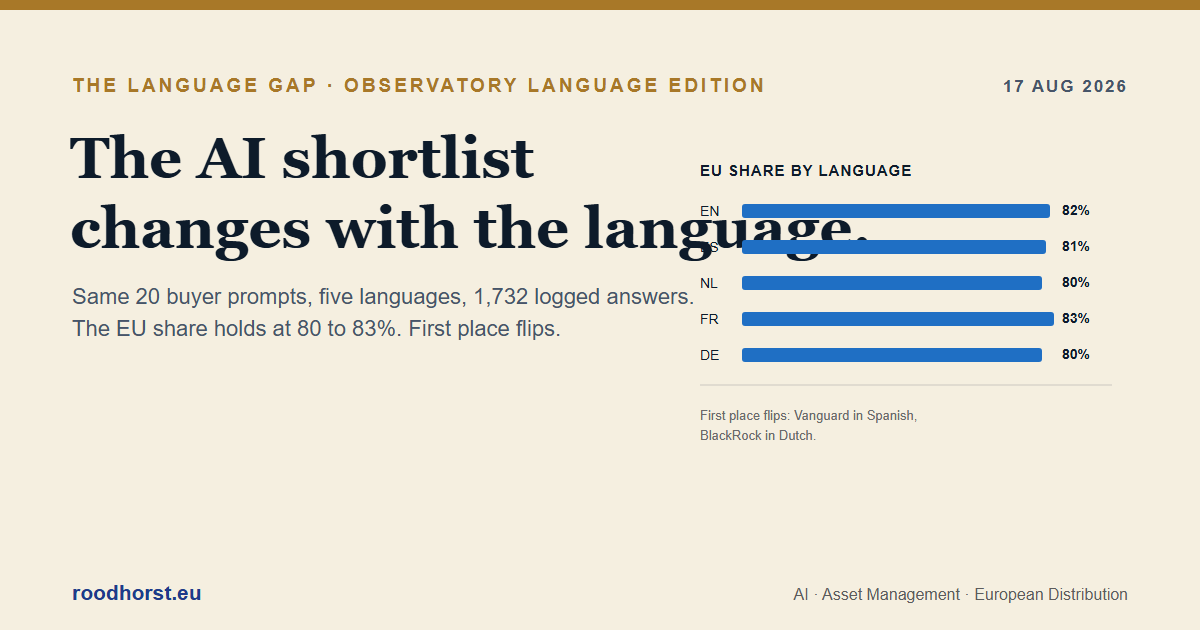
Same 20 buyer prompts, five languages, 1,732 logged answers. The EU share of the recommendation holds at 80 to 83 percent everywhere. Everything underneath it moves: who takes first place, which English leaders survive translation, and how much narrower the local answer gets. US giants still top the list when the question stays European.
This is the multilingual cut of the Observatory, showing which asset managers AI recommends across five languages.
The September 2026 re-read widens the panel to 2,243 answers across the same five languages (English 620, Spanish 472, Dutch 389, German 382, French 380). It holds every headline: EU firms take 80.9 to 83.2 percent of mentions in every language, Amundi leads reach in all five, and the only place the leader changes is Dutch recall, where BlackRock moves ahead of Amundi 65.7 to 63.5. The Index carries the current numbers.
Explore the reading
Pick a language to see its snapshot and league table. Search a firm, sort by share of voice or first-place hits.
English snapshot
League table
| # | Firm | Region | Share of voice | First place |
|---|
The five readings
All numbers trace to the saved raw answers. Charts are drawn from the same files as the tables.
Reading 01 · The aggregate holds
EU share of mentions vs US leakage by language, with top-10 concentration marked. The collapse headline is wrong; the narrowing is real.
Reading 02 · First place flips
Who gets the headline slot, per language. Reach and first place are different distribution events.
Reading 03 · The panel disagrees with itself
EU share with search on (grounded) vs off (recall). The aggregate holds in both modes; the winner can swap.
Reading 04 · The English top eight does not travel
Reach of the eight most-named firms in English, tracked into each language. Green cells gained share, red cells lost it.
Reading 05 · The machine shows home bias
The home-market effect: a firm’s reach at home versus in English, in percentage points.
The operator read
European financial services sell across markets, and the buyer in Frankfurt, Madrid, Paris or Amsterdam does not ask in English. The distribution reality has been multilingual for a decade. The recommendation layer is catching up, and the machine is not taking the English-only firm’s side.
The fix is structural work: publish in the buyer’s language, with citable statistics, visible FAQs and structured data, and make sure the local-language pages are open to AI crawlers. Most European financial firms still get robots.txt and llms.txt wrong, and the ones that get them right publish almost entirely in English. The gap is not translation. It is rebuilding the citable layer per market, which is the argument behind localise, translate or rebuild and the multilingual marketing reading.
I know the difference between translating a page and entering a market. I launched a Dutch brand in Germany from zero, and twelve months later it was an award-winning name in a category test. The win was not the translation; it was building proof, press and language-specific authority where the buyer lives. That is exactly what the local-language citation layer is: proof in the buyer’s language, on the machine’s reading surface.
This is measurable. This page is the language edition of the observatory: 1,732 logged answers in the Language Gap run, language and mode controls, and a searchable league table. It sits under the current Index, beside the financial homepage language study and the share-of-voice explainer as the family of instruments you can run yourself. The website side of the same question, which markets the firms themselves serve in the local language, is measured in the language of the country pages, counted.
Method and limits
The panel is the same as the observatory: a frozen set of twenty buyer and allocator prompts, a fixed roster of 108 European and global firm names with aliases, and identical counting rules. The English baseline was translated once and frozen before the first run. A firm counts when it is named in a saved raw answer; first place goes to the firm named earliest. The English baseline holds 591 answers across three engines (Gemini with search, Mistral, DeepSeek). The local panels ran 260 to 342 answers each in the Language Gap run, across 7 to 12 engine variants. The September 2026 re-read raises the total to 2,243 answers.
Read it as direction, not census. The multilingual rounds are newer than the English baseline, the engine mix differs per language, and grounded rounds are quota-bound. Compare reach within a language; treat cross-language deltas as direction. This measures what engines say, not fund quality or a ranking of managers. Raw answers are available on request.
The September 2026 re-read ran the same panel again on 2,243 answers and the limits hold with it: the engine set is wider than the English baseline, Dutch and French recall cuts are smaller than their grounded cuts, and moves under two points are sampling noise. What repeats is the shape: the aggregate holds, the shortlist does not travel, and the local champion gains at home.
Frequently asked
Do AI engines recommend different asset managers in different languages?
Yes. In the base reading, the same 20 prompts produced 1,732 answers across five languages. Amundi leads reach in all five, but first place flips: BlackRock wins first place in Dutch and Vanguard takes first in 57 Spanish answers. In the September 2026 re-read, on 2,243 Index answers, Amundi leads reach in all five again and the one place the leader changes is Dutch recall, where BlackRock moves ahead 65.7 to 63.5.
Why does the answer change with the language?
Grounded engines read the live web at the moment of the question, and most citable European financial content is published in English. Local-language sources are thinner and less structured, so the machine leans on the same global names and on local champions with local-language pages.
Does the European share of AI recommendations collapse outside English?
No. The EU share of mentions holds at 80 to 83 percent in every language tested. What changes is composition: who takes first place, which firms survive translation, and how concentrated the local answer is.
Which asset managers gain or lose when asked in a local language?
English-only citable surfaces lose: Legal & General IM falls from 35 percent in English to 10 percent in Spanish, BNP Paribas AM from 30 to 14, UBS Asset Management from 26 to 12. Local champions gain at home: DWS reaches 70 percent in German, Robeco 52 percent in Dutch, Carmignac 34 percent in French.
How do you measure AI share of voice by language?
With a frozen 20-prompt buyer panel translated 1:1 into each language, a fixed roster of 108 firm names and aliases, and identical counting rules. Every answer is saved as raw text, and reach and first place are counted per language.
What is the fix for a multilingual AI visibility gap?
Publish the citable layer in each buyer’s language: local-language statistics, visible FAQs, structured data, and pages open to AI crawlers. Then test in the buyer’s language, because the machine already localises its answer.
Is this a ranking of European asset managers?
No. It measures what AI engines say when asked to recommend, in five languages. It says nothing about fund quality, performance or AUM, and it is sampling, not a census.
The same question put to nine engines instead of three widens the gap rather than closing it, and the mode split moves the leader inside a single language. The Europe against the US index reading sets that cut beside the five-language run, so the two readings stay labelled rather than merged.
Cite this study
Roodhorst, V. (2026). The Language Gap: AI Shortlists Change With the Language. roodhorst.eu. https://roodhorst.eu/multilingual-ai-recommendations-european-asset-managers/
Sources & method
- The AI Asset-Manager Observatory, Q3 2026 – the English baseline, method and validation gate.
- The AI Share of Voice Index – the September 2026 re-read, 2,243 answers across five languages and nine engines.
- AI crawler rules at European financial firms – the robots.txt and llms.txt layer.
- The Financial Homepage Language Study – how language shows up on the homepage itself.
- Multilingual GEO protocol and raw answers – available on request.
1 thought on “The Language Gap: AI Shortlists Change With the Language”